
Angkor temples hit hard, even after the first photo. This private 3-day plan strings together the major classics and the lesser-known stops, with hotel pickup, A/C car, and a local English-speaking guide to help you make sense of what you are seeing.
I especially like the temple pacing. You get a full Day 1 with Banteay Srei and the quieter Angkor-area gems, then Day 2 ramps up to the big names like Bayon and Angkor Wat. The second thing I love is the private guide focus, which helps turn carvings, stone layouts, and Buddhist versus Hindu layers into something you can actually follow instead of just sightseeing.
One consideration: the headline price ($110) does not include temple tickets or the Tonle Sap boat fee, so your budget needs to include those add-ons.
Key things to know before you go
- Private A/C transportation with hotel pickup and drop-off keeps temple days sane
- English-speaking guide makes the history and symbols easier to read in real time
- Temple tickets and boat fee are extra, so price comparisons should include them
- A full Day 2 “master circuit” hits Angkor Thom, Bayon, Ta Prohm, and Angkor Wat
- Day 3 adds local life, with a boat outing on Tonle Sap at Chong Kneas
- Artisans Angkor is included with a stop at the school/workshops where crafts are taught
More temple circuits, set side by side
- Angkor Wat Sunrise or Sunset Tour with Guide from Siem Reap★ 5.0 · 12,109 reviews
- Siem Reap: Angkor Wat: Small-Group Sunrise or Sunset Tour★ 5.0 · 9,444 reviews
- Siem Reap: Angkor Wat 2-Day Tour with Sunrise and Sunset★ 4.9 · 4,429 reviews
- Siem Reap: Full-Day Angkor Wat Guided Tour with Sunset★ 4.9 · 3,803 reviews
Entering Angkor Archaeological Park with a private plan
Angkor Archaeological Park holds the remnants of several Khmer Empire capitals, mainly from the 9th to the 15th centuries. The place can feel confusing if you only rely on maps, because temples are not random. They are tied to rulers, religions, and city planning, and you will notice patterns once someone points them out.
This tour is built around that idea. You are not just visiting famous monuments. You are moving through a sequence that includes classic highlights plus smaller sites that help you understand how Angkor grew and changed over time. It also matters that the transport is private with A/C, because Angkor days involve a lot of time outside and on the road.
And yes, Angkor Wat really is massive. The point of a private plan is that you can look, stop, and re-look at details without feeling rushed by a group timetable.
Price and logistics: what $110 really covers
The tour price is $110, and you also get several solid inclusions:
- private transportation with A/C
- a private English-speaking tour guide
- drinking water
- hotel pickup and drop-off
- travel insurance
- mobile ticket
But the major cost items are listed separately:
- Temple ticket: $62 per person
- Boat fee to Tonle Sap: $15 per person
- Meals and beverages are not included
So for a realistic “all-in” estimate before meals, you are looking at about $187 per person ($110 + $62 + $15). Meals are the wildcard. If you plan to eat at least once or twice during the 3 days, that is where your total rises.
Where this becomes good value is the structure. You are paying for three days of private driving plus a guide who stays with you across multiple sites, not just dropping you at one monument for an hour. If you would otherwise rent a tuk-tuk and try to self-guide, this format usually makes more sense.
Day 1: Banteay Srei, Ta Som, Neak Pean, and Preah Khan
Day 1 starts with the kind of temple that sets your expectations. Banteay Srei is a 10th-century site often described as a jewel of classical Khmer art. It is known for intricate carving in pinkish sandstone. Even if you do not know the Khmer Empire timeline yet, the stonework tells a story: fine detail, careful ornamentation, and the feeling that the artisans were obsessed with precision. That matters because it trains your eye for what you will see later.
Next comes Ta Som, built in the late 12th century in the Bayon style under Jayavarman VII, with a Buddhist connection. This stop is shorter, so think of it as a “style check.” You start noticing the recurring Bayon-era language in the way faces, structures, and religious symbolism appear across different temples.
Then you visit Neak Pean, a smaller island temple set in the middle of the last baray constructed in the Angkor area. A baray is essentially a reservoir, tied to city life and ritual. Seeing a temple positioned this way makes it easier to understand that Angkor was built as a working system, not just a collection of monuments.
After lunch, the itinerary shifts into bigger scale at Preah Khan, a large monastic complex built by Jayavarman VII in the late 12th century. This is one of those places where being able to explore matters. The complex is described as highly explorable, which is ideal for a private guide, because they can help you choose what to focus on and how to read the layout without you getting lost in the maze.
A practical note for Day 1: temple tickets are not included, so you will want to make sure you have the required admission taken care of ahead of time. Also, since meals are not included, build in time and money for lunch so the afternoon flow stays comfortable.
Day 2: Angkor Thom South Gate, Bayon faces, Ta Prohm, and Angkor Wat
Day 2 is the heavy hitting day, and the sequence is smart. You start at Angkor Thom South Gate, where the design shows two opposing forces pulling the snake Shesha. The description includes 54 devas on one side and 54 asuras on the other, each pulling different parts of the serpent. These kinds of scenes help you understand that Angkor’s temple art is not decorative only. It is symbolic, theatrical, and tied to belief.
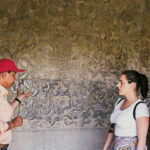
Then you go to Bayon, famous for its over 2,000 large stone faces carved on its towers. The bas-reliefs also matter here, because they depict everyday scenes, including markets, fishing, festivals, cockfights, and jugglers. This is one of the best places to shake off the idea that Angkor was all gods and no people. You are literally looking at the life that surrounded these temples.
From Bayon, the tour continues with Baphuon, built around the 11th century (noted as 1060) and dedicated to Siva, and then Phimeanakas, built around the late 10th to early 11th century and dedicated to Hindu worship under rulers named in the itinerary. These stops are shorter, but they keep the religious thread clear as the Khmer world shifts across Hindu and Buddhist layers over time.
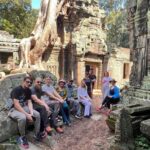
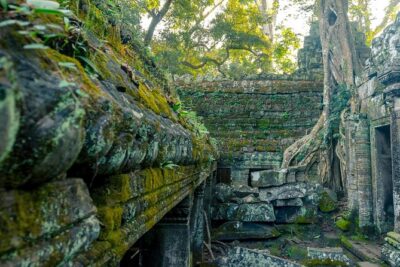
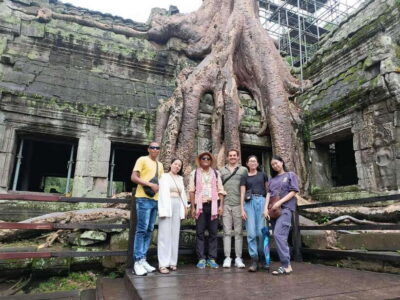
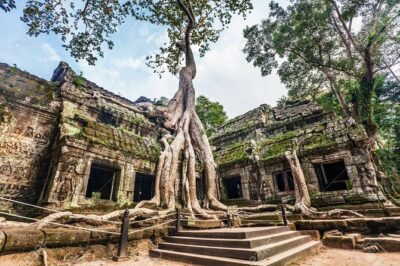
After that, Ta Prohm is the stop most people picture when they think of Angkor’s movie magic. It is wrapped in dense jungle, with fig, banyan, and kapok trees sending huge roots over the stone. The guide’s role is especially useful here, because it is easy to only focus on the roots and forget to look at the architecture beneath them. The temple is described as ethereal in aspect, and what that means in practice is you will likely keep changing where you stand, trying to see the stonework between the roots.
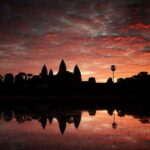
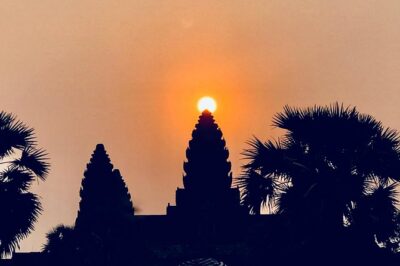
The day ends at Angkor Wat, originally Hindu and later Buddhist, and described as the largest religious monument in the world. It was built by King Suryavarman II in the early 12th century. If you only do Angkor Wat on a trip, you might still enjoy it a lot. But with this tour, you get the context of how Angkor Thom and Bayon set up the symbolism, then Ta Prohm adds a completely different mood, and Angkor Wat lands with full weight.
Day 2 is also where the private timing helps most. You want time to slow down, especially at Bayon faces and at Angkor Wat. Rushing kills details.
More time at the temples, spread over days

Day 3: Chong Kneas floating village plus Artisans Angkor workshops
Day 3 is not just “more temples,” which is exactly why it works. You head to Tonle Sap Lake for the floating village community at Chong Kneas. You take a boat and see the everyday lifestyle of three communities listed in the itinerary: Cambodia, Cham, and Vietnam.
This portion gives you a different angle on Cambodia. Angkor is about stone, rulers, and religion. Chong Kneas is about how people live with the water and how communities organize themselves around that reality. Even if you are mainly in Siem Reap for Angkor, this stop helps rebalance your brain by showing the country as it is today, not only as it was centuries ago.
After the lake, the tour includes Les Artisan D’Angkor (Artisans Angkor). The admission is listed as included, and the workshops focus on wood and stone carving, lacquering, silver plating, and silk painting. This is a practical add-on if you like the idea that you can connect what you saw carved in stone to what people are still making now.
If you care about crafts, this stop is a good final day closer. If you are temple-weary, it can feel like a relief.
The guide factor: Mr. Buth Chansip and why it matters
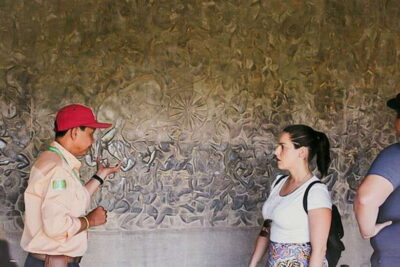
The most praised part of this experience is the guide quality. One name that stands out is Mr. Buth Chansip, described as the best tour guide, with a unique educational background and deep insight into a large set of temples over three days. That kind of guide does not just point out what exists. They help you understand why it was built, what the symbols mean, and how different temples relate to each other.
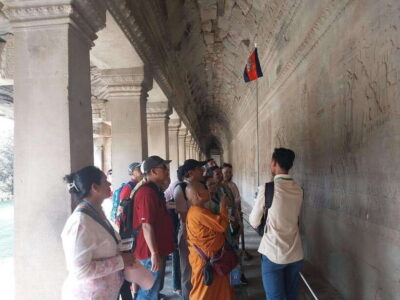
If you have ever been to a major site and felt like you were reading captions without understanding the story, you will appreciate this format. A private English-speaking guide means you can ask follow-up questions and get answers that fit your pacing.
Also, because this is a private tour, the guide can steer you toward what to focus on during each stop. You are not stuck watching what someone else in the group wants.
What you should plan for each day
This tour is three days, and it is structured around a lot of sites per day. That can be tiring if you are expecting a slow, chill schedule, but the private setup helps.
A few things to plan around based on the details provided:
- Temple tickets are not included. You will pay separately.
- Meals are not included, so you will need to budget time for eating, especially on Day 1 before you head to Preah Khan.
- Boat fee is not included for Tonle Sap, so the final day has an additional paid element.
- You get drinking water and travel insurance, which helps with basic comfort and peace of mind.
Timing matters too. Some stops are about 30 to 60 minutes, while others are shorter. That means you should have a realistic mindset: this is a discovery tour, but it is not a “stay all day at one temple” retreat.
Who this tour suits best
This is a strong fit if you want:
- private transport and a guide who can keep the story straight
- a route that covers both famous Angkor icons and additional temples in the Angkor area
- a balanced 3-day mix of temples plus local life at Tonle Sap
- less decision fatigue, because the itinerary already sets the order
It may be less ideal if you want total freedom to choose your own pace. This plan is designed to be efficiently full, especially on Day 2.
It is also a good match for couples and friends who prefer not to share vehicles and explanations with strangers. Since only your group participates, you can move at a pace that suits your interests.
Should you book this 3-day ancient temples tour?
I would book it if you want a well-rounded Angkor experience that does more than tick boxes. The private A/C setup plus a guide like Mr. Buth Chansip is the difference maker, because you get insight into the religious and artistic layers across the temples instead of just taking photos and hoping it clicks later.
I would think twice if your budget is tight, because temple admission plus the Tonle Sap boat fee add a meaningful amount on top of the $110 tour price. If you plan ahead and treat it as a true 3-day package, this tour delivers a lot for the money.
If you are excited to understand Angkor, not just see it, you will likely feel like the time is worth it.
FAQ
What is included in the $110 tour price?
The tour price includes private transportation with A/C, a private English-speaking tour guide, drinking water, hotel pickup and drop-off, travel insurance, and a mobile ticket.
What is not included?
Temple tickets are not included ($62 per person), the boat fee to Tonle Sap is not included ($15 per person), and meals and beverages are not included.
How long is the tour?
It is approximately 3 days, with multiple stops across Siem Reap and the Angkor area, plus Tonle Sap and Artisans Angkor on the third day.
Is this tour private?
Yes. It is described as a private tour/activity, so only your group participates.
Are hotel pickup and drop-off included?
Yes. Hotel pickup and drop-off are included, and pickup is offered.
What happens on Day 3?
Day 3 includes a boat visit to Chong Kneas floating village on Tonle Sap Lake, plus a stop at Les Artisan D’Angkor (Artisans Angkor), where the admission ticket is included.
Can I cancel for a full refund?
Yes, free cancellation is offered. You can cancel up to 24 hours in advance for a full refund. If you cancel less than 24 hours before the experience starts, the amount paid is not refunded.
Just Your Group: Private Days
- Full-Day Angkor Wat Sunrise Private Tour with Guide from Siem Reap
★ 5.0 · 2,920 reviews - Siem Reap: Angkor Wat Private Tuk-Tuk Tour
★ 4.9 · 2,222 reviews - Angkor Wat Private Day Tour from Siem Reap
★ 5.0 · 834 reviews - Angkor Wat Private Tuk-Tuk Tour (sunrise Option) & more
★ 5.0 · 439 reviews - Private Angkor Wat Day Tour – Best of Angkor
★ 5.0 · 269 reviews
More Days at the Temples
- Siem Reap: Angkor Wat 2-Day Tour with Sunrise and Sunset
★ 4.9 · 4,429 reviews - Angkor 2-Day Sunset & Sunrise Small-Group Tour
★ 5.0 · 2,567 reviews - 2 Days Exclusive Temple Highlights with Sunset and Sunrise Tour
★ 5.0 · 1,157 reviews - Siem Reap: Angkor Sunrise 1- or 2-Day Guided Temples Tour
★ 4.9 · 1,132 reviews - 2 Days Guided Historical Tour in Angkor
★ 5.0 · 855 reviews
More Temple Circuits Around Siem Reap
- Angkor Wat Sunrise or Sunset Tour with Guide from Siem Reap
★ 5.0 · 12,109 reviews - Siem Reap: Angkor Wat: Small-Group Sunrise or Sunset Tour
★ 5.0 · 9,444 reviews - Siem Reap: Angkor Wat 2-Day Tour with Sunrise and Sunset
★ 4.9 · 4,429 reviews - Siem Reap: Full-Day Angkor Wat Guided Tour with Sunset
★ 4.9 · 3,803 reviews - Angkor Wat Sunrise tour with Small – Group and Guide tours
★ 5.0 · 3,655 reviews
Just Added: Fresh Siem Reap Tour Reviews

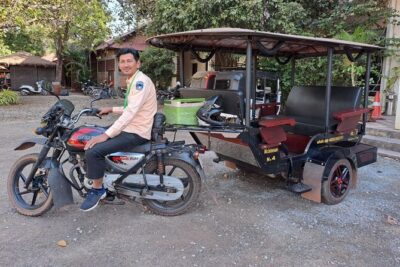
Angkor Temple Tours, compared.
 ★ 5.0Angkor Wat Sunrise or Sunset Tour with Guide from Siem ReapFrom $1812,109 reviews
 ★ 5.0Angkor Wat: Small-Group Sunrise or Sunset TourFrom $159,444 reviews
 ★ 4.9Angkor Wat 2-Day Tour with Sunrise and SunsetFrom $344,429 reviews
 ★ 4.9Full-Day Angkor Wat Guided Tour with SunsetFrom $153,803 reviews
 ★ 5.0Angkor Wat Sunrise tour with Small – Group and Guide toursFrom $143,655 reviews
 ★ 5.0Angkor Wat Highlights and Sunrise Guided Tour from Siem ReapFrom $233,213 reviews
 ★ 5.0Angkor Wat Sunset Small Group Tour with Lunch IncludedFrom $203,059 reviews
 ★ 5.0Full-Day Angkor Wat Sunrise Private Tour with Guide from Siem ReapFrom $602,920 reviews
Browse the lists this tour appears in