
Quiet temples, real Khmer detail. This Angkor Grand Circuit and Banteay Srei day trades the usual crowds for a route that reaches deeper into the park, plus a guided visit to one of Angkor’s most delicate carving sites. You’ll get pickup and drop-off, an English-speaking guide, and an air-conditioned ride, which makes a long day feel much easier to manage.
I love how the route leans less-visited and more peaceful, especially around Neak Pean and Ta Som, where you can actually stop and look instead of only walking. I also like the way the guide (many groups get Mr. K) focuses on timing and what to notice, including context beyond the stone walls, so each stop turns into a story you can follow.
One consideration: your ride is included, but temple admission isn’t, and the itinerary notes that at least Preah Khan requires the Angkor Pass (listed at $37 per person). If your schedule is tight or you hate long, warm walking days, you may want a shorter option.
Quick highlights you’ll feel right away
- A quieter Grand Circuit route that steps outside the most crowded Angkor routine
- Neak Pean and Ta Som for distinctive settings, including Ta Som’s tree-entwined gate
- Well-paced stops (most are about an hour, with longer time for the more detailed sites)
- Banteay Srei’s pink sandstone carvings that reward slow looking
- An English-speaking guide who manages timing and helps you read what you’re seeing
The pink sandstone carvings, a few more runs
- Full-Day Banteay Srei & 4 Temples – Grand Tours Join-in Tour★ 5.0 · 1,155 reviews
- Siem Reap Tour: Angkor Wat Sunrise, Bayon, Ta Prohm, Banteay Srei★ 5.0 · 931 reviews
- 2-Day Angkor Wat With Small, Big Circuit and Banteay Srei Tour★ 5.0 · 545 reviews
- From Siem Reap: Banteay Srei Temple & Grand 5 Temple Tour★ 4.8 · 262 reviews
A quieter Angkor day that still hits the headliners
Angkor can be two different experiences depending on when and where you go. On this tour, the plan is built around the Grand Circuit idea, which is all about getting to temples that feel more remote and calmer than the main clusters. That matters, because Angkor is not just about seeing famous towers. It’s about being able to stand back, notice carvings, and take in how the temple sits in its landscape.
You’ll start in the heart of the Angkor area, then work through a sequence that includes both Hindu and Buddhist-adjacent sites. Along the way, you get a mix of architectural layouts and some very specific visual moments. Neak Pean is famous for its artificial island temple setting. Ta Som is the one where the gate looks like the roots have claimed it. And by the time you reach Banteay Srei, you shift from “wow, big structures” to “wow, tiny details.”
This is the kind of day that works best when you want more than a checklist. If you like the feeling of having time, you’ll appreciate the flow.
Price and value: $50 plus what the Angkor Pass adds
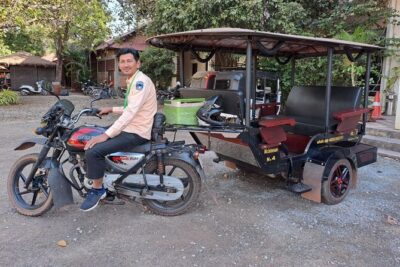
The tour price is $50 per person for a 6 to 8 hour experience in Siem Reap. On the included side, you get pickup and drop-off, an air-conditioned vehicle, an English-speaking guide, and cold drinking water. In practical terms, that means you’re paying for someone to handle routing, timing between sites, and the transport between them.
What you need to budget for separately is temple admission. The tour lists the Angkor Pass as $37 per person and notes that admission is not included, with Preah Khan specifically marked as not included. Other stops in the itinerary are marked as free admission, so your total may depend on which sites are covered during your day. Still, treat the pass as the most likely extra cost.
Is it good value? For many visitors, yes, because you’re not just getting a driver. You’re getting guided context and a route that goes beyond the simplest “one complex, one day” approach. If you’ve already done the core temples and want the park’s calmer corners, this day can feel like a smart add-on rather than a duplicate.
The flow of the Grand Circuit: why this route feels different
The Grand Circuit gets described as a more peaceful alternative for a reason. The big name areas can be intense, and even if you love Angkor, crowds can steal your attention. Here, the sequence supports a different pace.
Most of the stops are about an hour. That’s long enough to absorb the layout and take a few slow minutes for photos, without turning the day into a marathon. Then you get longer stretches where the temple matters more than the clock, especially as you reach the more intricate sites later.
Another reason this route feels good is the variety of temple purposes and styles. Even when you’re not reading Khmer inscriptions (and you usually won’t be), the buildings communicate through structure. Hindu temple logic shows up through tiered forms and symbolic towers. Buddhist influence shows up through different temple functions and settings. You’ll feel that shift as the itinerary moves from Preah Khan’s setting to the island temple of Neak Pean, then out to the smaller, detail-forward Banteay Srei.
If you want Angkor to feel like a living culture, not a theme park, this kind of routing helps.
Stop 1: Preah Khan, a big 12th-century temple day starter
Preah Khan is a 12th-century temple built for King Jayavarman VII to honor his father. It’s located northeast of Angkor Thom and just west of the Jayatataka baray. The tour includes about 1 hour here, and admission is marked as not included for this stop.
What you can expect is a classic Angkor feel right away. Preah Khan is the kind of temple where you start noticing how the site is organized. Even in an hour, you should be able to get a sense of the temple’s role in the larger Angkor system, especially because this stop sits near the baray area.
Practical note: since admission may be part of your Angkor Pass plan, double-check your pass coverage before you get to this stop. It’s the one in your itinerary explicitly flagged as not included.
Round the grand circuit, a few more stops

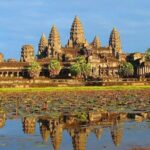
Stop 2: Neak Pean, the island temple moment
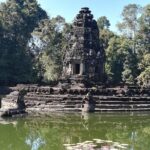
Neak Pean is one of the most distinctive stops because it’s an artificial island temple set in Jayatataka Baray. It’s associated with Preah Khan, and the tour gives you about 1 hour, with admission marked as free.
This is the stop that changes your mood. You’re not just walking between ruins. You’re stepping into a scene that feels staged by water. The circular island and the temple placement make Neak Pean feel like a quiet pause inside the day.
If you’re the type who enjoys atmosphere as much as architecture, you’ll like this one. It’s also a good place to slow down. Look for the way the island shape frames the temple, then look again at the carvings and openings, because the view changes as you move around.
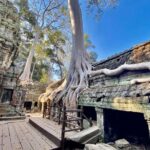
Stop 3: Ta Som, the tree-entwined gate photo that actually matters
Ta Som is a late 12th-century temple built for King Jayavarman VII. It’s located northeast of Angkor Thom and just east of Neak Pean, and the tour gives you about 1 hour. Admission is marked as free for this stop.
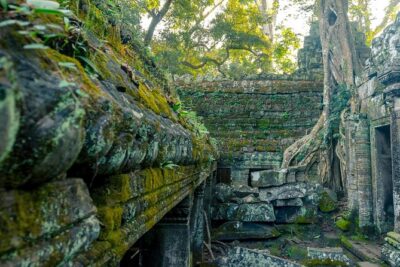
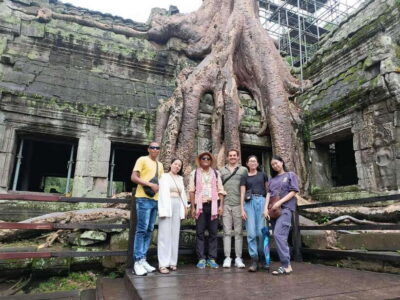
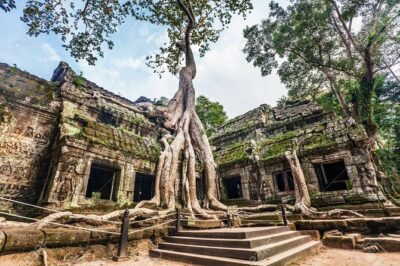
Ta Som is the temple with the striking gate where the tree roots look like they’re part of the architecture. This is one of those Angkor moments that works even if you’ve seen photos before. In person, the scale and the angle of roots make it feel less like an accident and more like a slow takeover.
A guide is useful here because you’ll get more than the spectacle. With the right explanations, you can understand how the temple layout supports the dramatic gate view, and what features to look at beyond the obvious doorway.
Stop 4: Eastern Mebon, five towers and die-roll symbolism
Eastern Mebon has a distinctive tower arrangement, with five towers laid out like the numbers on a die atop a base with three tiers. The whole is surrounded by three enclosures. You’ll have 1 hour here, and admission is marked as free.
This stop is for people who like structure. It’s less about wandering and more about seeing the geometry. If you take a few minutes to step back, you’ll better appreciate how the tiers and enclosures work together.
In a day with several different temple moods, Eastern Mebon is a nice mental reset. It’s a chance to shift from “where’s the most impressive view” to “how is this composed.”
Stop 5: Banteay Samre, the longer mid-day breathing space
Banteay Samré is a temple near the East Baray. It’s built during the reign of Suryavarman II and Yasovarman II in the early 12th century, and it’s described as a Hindu temple in the Angkor area. The tour allots about 2 hours here, with admission marked as free.
That extra time is telling. Two hours at this point in the day lets you take things more slowly. If earlier stops felt more about getting your bearings, Banteay Samré gives you room to understand how the site sits in relation to the surrounding water area.
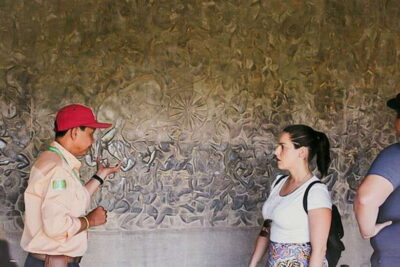
This is also a spot where a guide can add value by pointing out what to notice in carvings and architectural transitions. Even when you’re not an expert, being shown where to look turns “stone walls” into “details with meaning.”
Stop 6: Banteay Srei, the pink sandstone carvings that slow you down
Banteay Srei, also spelled Banteay Srey, is the centerpiece detour in this tour. It’s a 10th-century temple dedicated to Shiva, located near Phnom Dei hill, about 25 km northeast of the main group of temples. The tour gives you 2 hours here, and admission is marked as free in the itinerary.
This temple is famous for its highly intricate 3D carvings in a soft, pinkish sandstone. It’s relatively small compared to other major Angkor sites, which is exactly why it rewards careful viewing. When carvings are delicate and close, you stop moving so fast.
Another detail that makes Banteay Srei feel special is that it was not commissioned by a king, but by a Brahman courtier. That context can help you interpret what you see. Instead of thinking only in terms of royal propaganda, you start paying attention to craft and devotion.
If you’re choosing between tours, this is the reason to consider one that includes Banteay Srei. It’s not just pretty stone. It changes how Angkor feels. You go from monumental scale to careful craftsmanship.
Timing and comfort: making 6 to 8 hours feel manageable
You’re out for about 6 to 8 hours, so the biggest practical challenge is physical comfort. Even with AC in the vehicle, you’re still spending time at multiple open-air temples.
A few strategies that work well:
- Start thinking in “chunks.” Each stop is about an hour, so plan to reset mentally at every drive.
- Wear breathable clothes and shoes you can walk in for stretches, because your day will likely include uneven ground and a lot of standing.
- Use the included cold water to take the edge off early, not after you’re already tired.
The tour includes cold drinking water and pickup and drop-off, which helps you conserve energy and keep the day smooth. Also, because it’s a private tour/activity, you’re not tied to random group pacing.
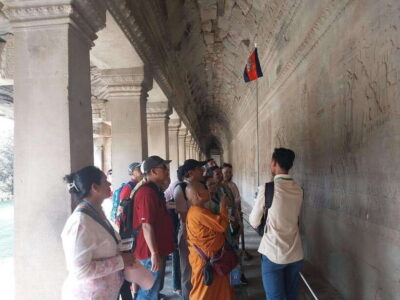
If you get Mr. K as your guide, that can be a bonus. The reviews highlight that he’s informative and attentive, and that he knows good times of day to visit temples. That kind of guidance matters because timing changes how you feel inside each stop.
Who should book this Angkor Grand Circuit and Banteay Srei tour
This tour fits best if you:
- Already did the main Angkor Wat and Angkor Thom style sites and want a quieter follow-up day
- Prefer less crowded temple time where you can actually look
- Want a guide who helps you read what you’re seeing, not just drive you from point to point
- Appreciate fine carving work and especially want Banteay Srei
It may be less ideal if you:
- Want a short visit that avoids a full day
- Don’t want any temple admission add-ons
- Hate walking and standing for multiple stops
Should you book? My take on the decision
Book it if you want Angkor to feel calmer and more personal. The mix of Grand Circuit-style temples and the craft focus of Banteay Srei is a strong combo, especially for people who feel temple fatigue after just the most famous sights.
Skip it or switch to a shorter plan if you’re mainly chasing the absolute biggest crowd magnet areas and you’d rather not think about the Angkor Pass cost. Also, if your day already includes multiple temple stops, consider whether a Banteay Srei focus might be better on a lighter schedule.
Bottom line: for the price, the included transport comfort, and the chance to spend real time on Neak Pean, Ta Som, and Banteay Srei, this is a smart way to see a different side of Angkor without rushing.
FAQ
Where is this tour located?
The tour is in Siem Reap, Cambodia.
How long does the Angkor Grand Circuit and Banteay Srei tour take?
It’s listed as 6 to 8 hours (approx.).
What does it cost?
The price is $50.00 per person.
Is pickup and drop-off included?
Yes, pickup and drop-off are included.
Do you get an English-speaking guide?
Yes, an English-speaking tour guide is included.
Are temple admission fees included?
No. Admission fees are listed as not included, and the Angkor Pass is noted at $37.00 per person. The itinerary also marks admission for Preah Khan as not included, while other stops are marked as free admission.
Is this a private tour?
Yes. It’s described as private, with only your group participating.
What’s included for comfort during the day?
An air-conditioned vehicle and cold drinking water are included.
Can I cancel for free?
Yes, free cancellation is available. You can cancel up to 24 hours in advance for a full refund.
More Temple Circuits Around Siem Reap
- Angkor Wat Sunrise or Sunset Tour with Guide from Siem Reap
★ 5.0 · 12,109 reviews - Siem Reap: Angkor Wat: Small-Group Sunrise or Sunset Tour
★ 5.0 · 9,444 reviews - Siem Reap: Angkor Wat 2-Day Tour with Sunrise and Sunset
★ 4.9 · 4,429 reviews - Siem Reap: Full-Day Angkor Wat Guided Tour with Sunset
★ 4.9 · 3,803 reviews - Angkor Wat Sunrise tour with Small – Group and Guide tours
★ 5.0 · 3,655 reviews
Along the Grand Circuit
- Siem Reap: Banteay Srei and Grand Circuit Heritage Tour
★ 4.9 · 163 reviews - Banteay Srei and Grand Circuit Heritage Tour from Siem Reap
★ 5.0 · 142 reviews - 2-Day Private Tour in Angkor Wat Grand Circuit
★ 5.0 · 23 reviews - Preah Khan, Ta Prohm, Bayon Off Beaten Track
★ 5.0 · 8 reviews - Angkor Grand Circuit Temples Tour
★ 5.0 · 8 reviews
The Carvings of Banteay Srei
- Full-Day Banteay Srei & 4 Temples – Grand Tours Join-in Tour
★ 5.0 · 1,155 reviews - Siem Reap Tour: Angkor Wat Sunrise, Bayon, Ta Prohm, Banteay Srei
★ 5.0 · 931 reviews - 2-Day Angkor Wat With Small, Big Circuit and Banteay Srei Tour
★ 5.0 · 545 reviews - From Siem Reap: Banteay Srei Temple & Grand 5 Temple Tour
★ 4.8 · 262 reviews - 3-Days Discovery Of Angkor: Waterfalls,Floating Village and Banteay Srei temple
★ 5.0 · 214 reviews
Just Added: Fresh Siem Reap Tour Reviews

Angkor Temple Tours, compared.
 ★ 5.0Angkor Wat Sunrise or Sunset Tour with Guide from Siem ReapFrom $1812,109 reviews
 ★ 5.0Angkor Wat: Small-Group Sunrise or Sunset TourFrom $159,444 reviews
 ★ 4.9Angkor Wat 2-Day Tour with Sunrise and SunsetFrom $344,429 reviews
 ★ 4.9Full-Day Angkor Wat Guided Tour with SunsetFrom $153,803 reviews
 ★ 5.0Angkor Wat Sunrise tour with Small – Group and Guide toursFrom $143,655 reviews
 ★ 5.0Angkor Wat Highlights and Sunrise Guided Tour from Siem ReapFrom $233,213 reviews
 ★ 5.0Angkor Wat Sunset Small Group Tour with Lunch IncludedFrom $203,059 reviews
 ★ 5.0Full-Day Angkor Wat Sunrise Private Tour with Guide from Siem ReapFrom $602,920 reviews
Browse the lists this tour appears in