
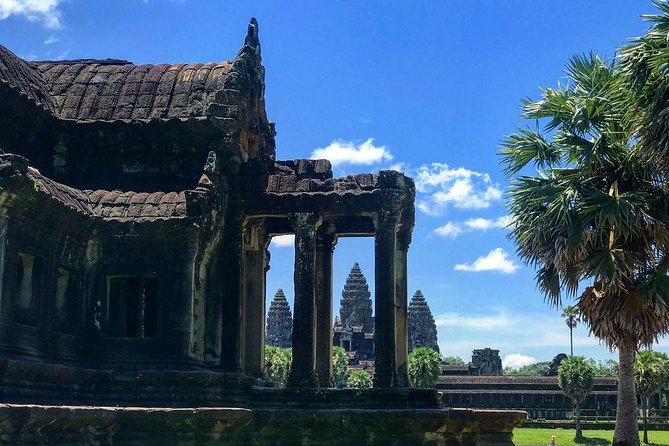
Reviewed · ANGKOR SUNRISE & SUNSET TOURS
2 Days Temples with Sunrise-Small Group
A sunrise over Angkor changes everything. This small-group temples sprint is built for early hours and efficient routes, with an English guide, Sok, who helps you see more than just the postcard views. I like the way you avoid the worst crowd crush while still hitting the big names, and I also appreciate the practical extras, like mineral water and the cool flannels passed between stops by driver Richard. One thing to plan for: the temple pass fee is not included, so your budget needs that extra cost, plus you should expect an early day two wake-up.
You get a focused mix of Hindu and Buddhist sites, plus a classic outside-Angkor circuit. Day one leans into atmosphere and craftsmanship, like Banteay Srei’s carvings and the root-choked drama of Preah Khan. Day two climbs into the heart of Angkor, starting with sunrise at Angkor Wat and ending with Bayon’s face towers.
Key Stops That Make This 2-Day Plan Work
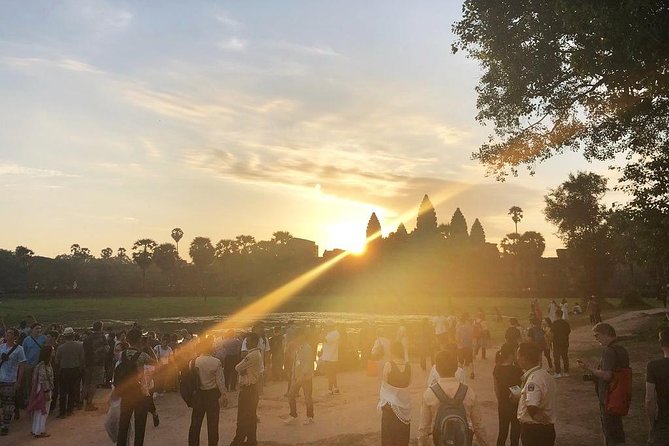
- Sunrise access at Angkor Wat with a torch tip so you can enter in darkness and make the most of your morning light
- Outside-Angkor circuit on day one, including Pre Rup, Banteay Srei, Preah Khan, and Neak Pean
- Ta Prohm’s jungle look is a top priority here, not a rushed quick photo stop
- Bayon’s huge face towers are visited on day two for that classic Angkor finale feel
- Small group cap of 15 helps keep the pace comfortable and the guide’s attention closer
- Hotel pickup plus air-conditioned transport makes the long temple days feel more manageable
Chasing the light? More dawn and dusk runs
- Angkor Wat Sunrise or Sunset Tour with Guide from Siem Reap★ 5.0 · 12,109 reviews
- Siem Reap: Angkor Wat: Small-Group Sunrise or Sunset Tour★ 5.0 · 9,444 reviews
- Sunset tour of Kampong Phluk stilts home village on the Tonle Sap★ 5.0 · 4,865 reviews
- Siem Reap: Angkor Wat 2-Day Tour with Sunrise and Sunset★ 4.9 · 4,429 reviews
Price and Value: What Your $43 Really Buys
The headline price is $43 per person for a 2-day tour. That sounds like a steal, and in many ways it is, as long as you understand the one big add-on: the temple pass.
The temple pass is $62 per person, payable on the day of your activity. So the realistic total you should budget for is about $105 all-in, assuming one pass per person. Also note the tour lists some stops as free for admission while others are not. That said, the pass surcharge is still part of the plan, because Angkor sites can be split across rules and ticket requirements.
Where the value shows up is not just in the sights. You’re paying for:
- a licensed English-speaking guide, Sok
- a small group (maximum of 15)
- hotel pickup and drop-off
- air-conditioned vehicle transport between temples
- mineral water during the day
- local tax included in the tour price
- a mobile ticket
In other words, you’re not just buying temple entrances and a driver. You’re buying interpretation, timing, and route logic. In Angkor, those three things matter more than people expect.
Small-Group Tempo and the Angkor-Ready Logistics
This is a compact 2-day plan, which means your schedule is busy, but not chaotic. The max of 15 travelers is a sweet spot. With a larger crowd, you lose time at entrances and you spend more of the day waiting for everyone to get the same piece of information. Here, the group size keeps the flow tighter.
Transport is in an air-conditioned vehicle, which matters a lot when you are out temple-hopping in Cambodia heat. You also get mineral water, plus cool flannels between stops, which is a small detail that can feel surprisingly important once you’ve walked some stone stairs.
The other key logistics piece is your wake-up call for sunrise. The tour recommends requesting a wake-up call so you do not miss day two. This is not a “sleep in and stroll” kind of morning. You’ll be leaving your hotel early for sunrise, and Angkor Wat looks completely different before the crowds and before the heat.
Day 1: Pre Rup, Banteay Srei, Preah Khan, Neak Pean
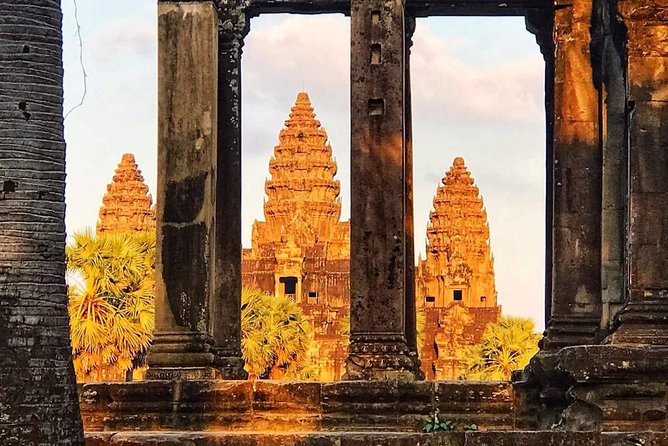
Day one is about building the Angkor feeling before you hit the main complex. You’ll focus on temples outside Angkor Thom city, with a nice mix of Hindu and Buddhist influences.
Pre Rup: Brick, stone, and big views
You start at Pre Rup for about 30 minutes. This is a Hindu temple built as the state temple of Khmer king Rajendravaman. Even in a short stop, it’s a great opener because it sets expectations for how these sites were designed, as places meant to be experienced from multiple angles, not just stared at from one spot.
If you like temples that feel a bit rough around the edges, Pre Rup delivers. It’s less smooth and polished than some of the headline sites, and that helps the whole area feel real, not staged.
More temple circuits, set side by side
Banteay Srei: The carvings that make people pause
Next is Banteay Srei, around one hour. This temple is smaller, sandstone, and famous for its detailed reliefs. The tour description flags it as among the finest and most skillfully crafted in Cambodia, and that reputation holds up because the carving work rewards slow looking.
Banteay Srei is also listed as an admission ticket free stop in the schedule. That means you can spend your time on the details rather than worrying about extra entry fees for that particular stop.
Practical tip: bring your patience. Close-up carving work is not fast. If you rush, you miss the best part.
Preah Khan: Trees, roots, and an atmospheric ruin
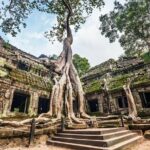
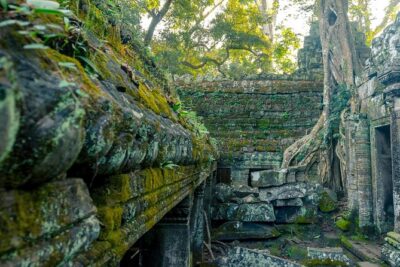
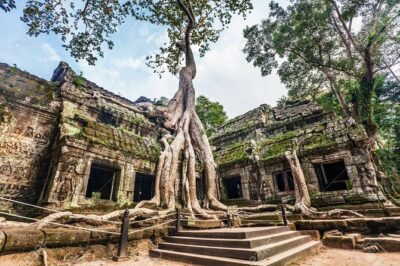
After that, you move on to Preah Khan for about 2 hours. This is where the tour leans hard into atmosphere: a ruined temple site with tree roots and crumbling stone structures. It was commissioned by the Khmer king Jayavarman VII, and that historical layer helps explain why the site feels both sacred and wild.
If you’ve seen pristine temples only, Preah Khan changes the mood. The textures do the storytelling here. Roots grab the stones. Old walls crumble. The place feels like time is still happening.
The schedule notes that admission is not included for this stop, so keep your pass and site rules in mind.
Neak Pean: A calm break on an artificial island
You finish day one at Neak Pean, about 50 minutes. This is an artificial island with a Buddhist temple on a circular island in Jayatataka Baray. The concept is cool because it’s not just a single shrine, it’s a temple placed into a larger water feature system.
This is a good place to reset your legs. You’ve already walked and climbed a few times, and Neak Pean can feel more spacious and reflective than some tighter temple layouts.
Day 2: Sunrise at Angkor Wat, Then Ta Prohm and Bayon
Day two is the big spotlight. You start with sunrise at Angkor Wat, then work through major Angkor stops, ending with Bayon’s face towers.
Angkor Wat sunrise: Entering in darkness
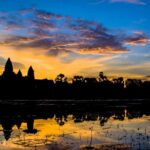
Angkor Wat is scheduled for about 2 hours 5 minutes, and it’s the star: pre-dawn departure, sunrise viewing, and a special note about entering the temple in darkness. The tour specifically advises you to bring a torch.
You’re not just watching a sunrise from a viewpoint. You enter and move through the temple early. That helps you get your bearings fast and gives the site a quiet, almost ghost-like feel before most people arrive. The route described includes entry from the eastern side, which can help you experience the temple from a less expected angle.
Practical note: a torch is one of those items you think you can improvise, then regret. Even a small handheld light can save you from awkward stumbling on stone steps.
Srah Srang: Breakfast and a breather
Then you stop at Srah Srang for about 50 minutes. This is a free admission stop in the schedule, and the morning includes breakfast at a Khmer local restaurant. The tour notes that breakfast can be taken away from your hotel or ordered there.
This part is not about the temple selfie. It’s about recovering. You’ve already done sunrise walking. Getting food and a short sit down helps you keep energy for the afternoon.
Ta Prohm: Jungle energy without rushing
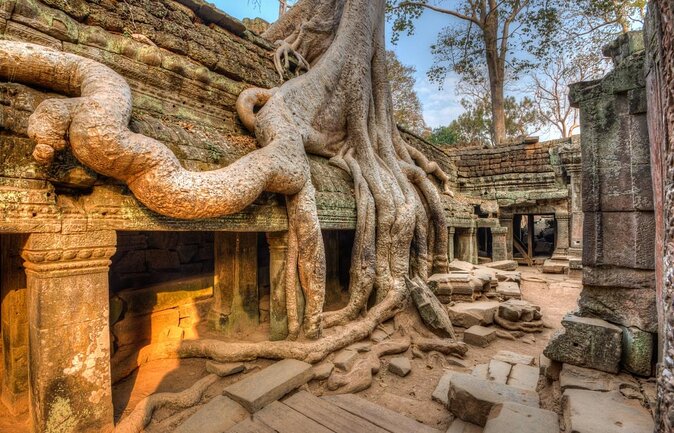
After a rest break, you head to Ta Prohm for about one hour. Ta Prohm is scheduled as the jungle-enveloped temple, and it’s one of the most atmospheric sites in Angkor. The tour mentions it was once home to 2,740 monks, which helps you think beyond the modern movie-famous look and into what daily life may have been like here.
If you only see Ta Prohm for a quick 10 minutes, you get the famous trees. If you slow down for the full hour, you also start to notice how the stone and root structures interact, and why it feels so staged even though it is not.
As with several other stops, admission is not included here.
Terrace of the Elephants and the Leper King
Next you pass the Terrace of the Leper King and the Terrace of the Elephants. This is a short stop, about 20 minutes, and it is listed as free admission. Don’t expect a long lecture here, but do expect you to be reminded what makes Angkor famous: bas-relief scenes and sculpted stone narratives.
Even a quick stop can be rewarding if you pick one section to focus on and let your guide explain what you are seeing.
Bayon: Those faces at the center
Finally, you reach Bayon for about one hour. This is described as the 12th-century Bayon with central towers covered in more than 200 enormous faces. This is one of those sights where photos do not quite capture the scale and repetition.
The faces can feel playful, serious, or slightly spooky depending on where the light hits. When your guide ties that visual effect to the temple’s purpose and era, Bayon becomes more than a set of carvings. It becomes a way to understand how Khmer rulers wanted to be seen.
Admission is not included for this stop, so make sure you have your temple pass sorted.
Who This Tour Fits Best (and Who Might Want Something Different)
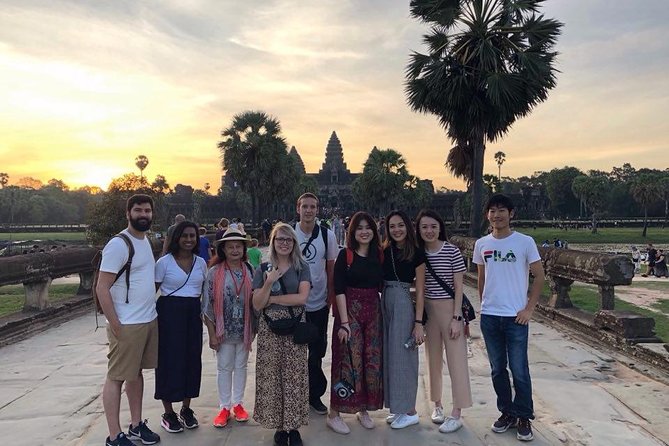
This tour is for you if you want:
- a small-group experience without feeling stuck in a bus parade
- a guide who explains what you’re seeing and where to look
- a tight 2-day hit list: outside temples day one, major Angkor day two
- sunrise at Angkor Wat, plus classic stops like Ta Prohm and Bayon
It might not be the best match if you prefer slower travel with lots of free time. This schedule packs a lot into two days. It is doable, but it is not a “see one temple per hour” kind of plan.
Also, there are age limits: children must be accompanied by an adult, and younger than 5 years old are not allowed.
Temple Pass, Dress Code, and What to Bring
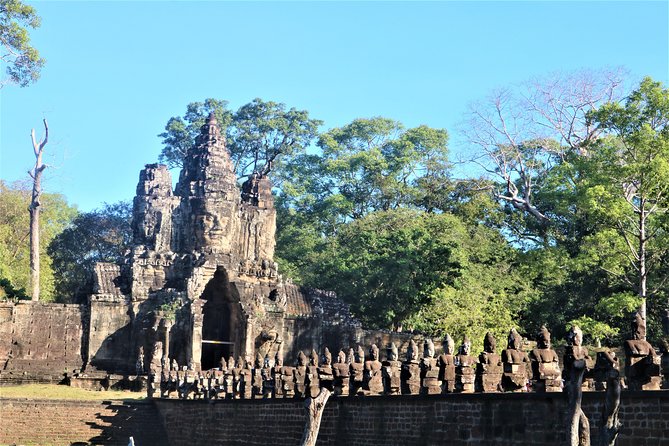
A few basics will save you headaches at the gates.
Temple pass
Your tour price does not include the $62 temple pass. The tour states the pass is payable on the day of your activity. Keep that in mind for budgeting and for planning your arrival time.
Dress code
Casual is fine, but shoulders and knees must be covered inside temples. If you show up with tank tops and shorts, you may have to fix it on the spot. That can eat time and patience.
Shoes and gear
Comfortable walking shoes are recommended. Sunrise at Angkor Wat also comes with the torch advice. Plan for early darkness, stone steps, and a few longer walking stretches.
The Guides and the Little Touches That Matter
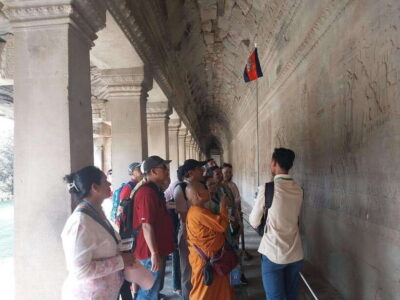
The experience stands out for its human pieces. The guide, Sok, is highlighted in the reviews as a key reason people loved the trip. He is the one explaining the temples, their carvings, and the meaning behind what you see.
You’ll also feel the team vibe with driver Richard. One review specifically called out water and flannels between stops. That’s not a luxury upgrade, it’s a practical comfort move. In Angkor heat, small cooling breaks help you keep going, and it shows someone is thinking about how your day actually feels.
Should You Book This Tour?
Book it if you want a smart 2-day structure, sunrise at Angkor Wat, and a guide-led route that covers the big Angkor hits plus major temples outside Angkor Thom. The small-group cap, hotel pickup, air-conditioned transport, and the on-the-go comfort touches make it feel like a well-run plan rather than a mad dash.
Consider booking something else if you hate early wake-ups or you want lots of downtime. This is a “temples first” schedule.
One more reason to feel confident: there is free cancellation up to 24 hours in advance for a full refund, and the tour notes it depends on good weather. If weather is poor, you are offered a different date or a full refund. That flexibility helps when your itinerary has travel days built around sightseeing.
FAQ
Is the temple pass included in the tour price?
No. The temple pass is not included and costs $62.00 per person. It is payable directly on the day of your activity.
What temples are included over the two days?
Day one includes Pre Rup, Banteay Srei, Preah Khan, and Neak Pean. Day two includes sunrise at Angkor Wat, Srah Srang, Ta Prohm, Terrace of the Elephants and the Terrace of the Leper King, and Bayon.
Do I need a torch for sunrise at Angkor Wat?
Yes. The schedule advises you to bring a torch because you enter the temple in darkness from the eastern side for the sunrise experience.
Does the tour offer hotel pickup and drop-off?
Yes. Hotel pickup and drop-off are included.
How many people are in the group?
The tour has a maximum group size of 15 travelers.
Are meals included?
Meals are not included. Breakfast is mentioned on day two at a Khmer local restaurant, but the schedule indicates meal details are not part of the standard included pricing.
What should I wear to visit the temples?
Casual clothes are fine, but shoulders and knees must be covered inside temples.
More Days at the Temples
- Siem Reap: Angkor Wat 2-Day Tour with Sunrise and Sunset
★ 4.9 · 4,429 reviews - Angkor 2-Day Sunset & Sunrise Small-Group Tour
★ 5.0 · 2,567 reviews - 2 Days Exclusive Temple Highlights with Sunset and Sunrise Tour
★ 5.0 · 1,157 reviews - Siem Reap: Angkor Sunrise 1- or 2-Day Guided Temples Tour
★ 4.9 · 1,132 reviews - 2 Days Guided Historical Tour in Angkor
★ 5.0 · 855 reviews
More Temple Circuits Around Siem Reap
- Angkor Wat Sunrise or Sunset Tour with Guide from Siem Reap
★ 5.0 · 12,109 reviews - Siem Reap: Angkor Wat: Small-Group Sunrise or Sunset Tour
★ 5.0 · 9,444 reviews - Siem Reap: Angkor Wat 2-Day Tour with Sunrise and Sunset
★ 4.9 · 4,429 reviews - Siem Reap: Full-Day Angkor Wat Guided Tour with Sunset
★ 4.9 · 3,803 reviews - Angkor Wat Sunrise tour with Small – Group and Guide tours
★ 5.0 · 3,655 reviews
Dawn and Dusk Over Angkor
- Angkor Wat Sunrise or Sunset Tour with Guide from Siem Reap
★ 5.0 · 12,109 reviews - Siem Reap: Angkor Wat: Small-Group Sunrise or Sunset Tour
★ 5.0 · 9,444 reviews - Sunset tour of Kampong Phluk stilts home village on the Tonle Sap
★ 5.0 · 4,865 reviews - Siem Reap: Angkor Wat 2-Day Tour with Sunrise and Sunset
★ 4.9 · 4,429 reviews - Siem Reap: Full-Day Angkor Wat Guided Tour with Sunset
★ 4.9 · 3,803 reviews
Just Added: Fresh Siem Reap Tour Reviews
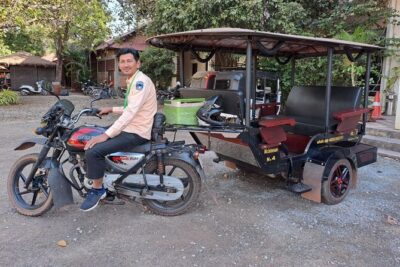
Angkor Sunrise & Sunset Tours, compared.
 ★ 5.0Angkor Wat Sunrise or Sunset Tour with Guide from Siem ReapFrom $1812,109 reviews
 ★ 5.0Angkor Wat: Small-Group Sunrise or Sunset TourFrom $159,444 reviews
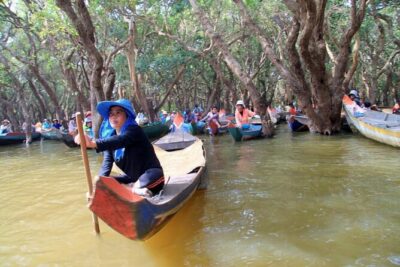 ★ 5.0Sunset tour of Kampong Phluk stilts home village on the Tonle SapFrom $214,865 reviews
 ★ 4.9Angkor Wat 2-Day Tour with Sunrise and SunsetFrom $344,429 reviews
 ★ 4.9Full-Day Angkor Wat Guided Tour with SunsetFrom $153,803 reviews
 ★ 5.0Angkor Wat Sunrise tour with Small – Group and Guide toursFrom $143,655 reviews
 ★ 5.0Angkor Wat Highlights and Sunrise Guided Tour from Siem ReapFrom $233,213 reviews
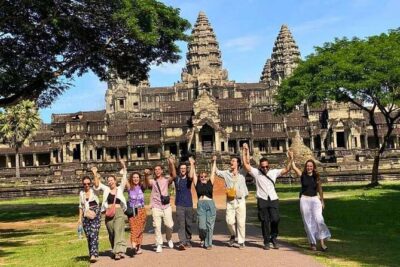 ★ 5.0Angkor Wat Sunset Small Group Tour with Lunch IncludedFrom $203,059 reviews
Browse the lists this tour appears in