
Reviewed · ANGKOR TEMPLE TOURS
Shared day tour with Spanish-speaking guide at Angkor Temple.
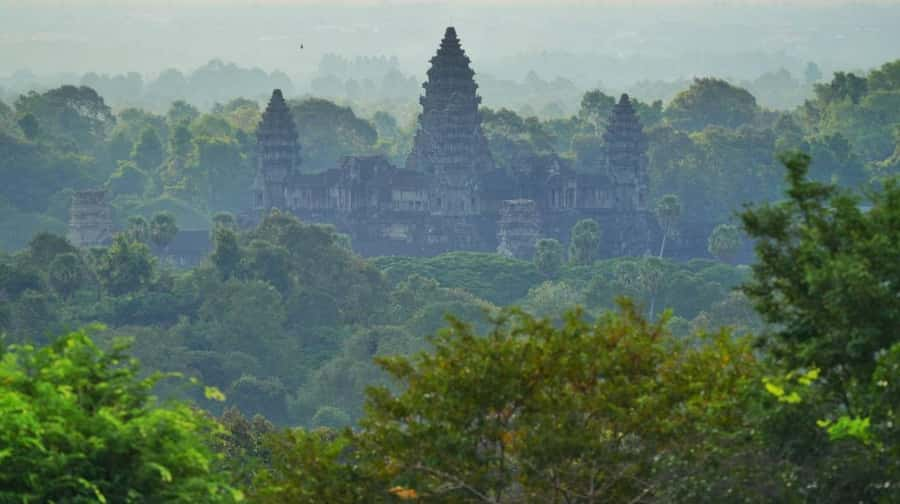
Angkor feels like a puzzle you can actually solve. This shared day tour uses a Spanish-speaking guide and a small group size to help the sites make sense, from the fortified city of Angkor Thom to the iconic Angkor Wat complex.
I especially like two things: you get a guided route that hits several of the most recognizable temples, and the size of the group stays under control, limited to 9 participants. One thing to consider is that it is a full day on your feet, and the tour is not suitable if you weigh more than 331 lbs (150 kg).
Key things to know before you go
- Small group size (up to 9) helps you move faster and ask more questions
- Guide languages include Spanish, Portuguese, and English for mixed-language groups
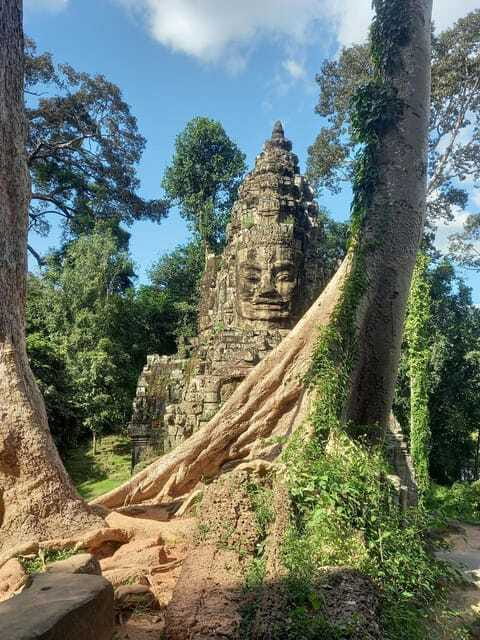
- Angkor Thom South Gate on a causeway lined with demons and gods, plus giant naga
- Bayon faces plus two named terraces gives you variety in carved scenes
- Ta Phrom in the jungle offers a contrast to the more formal temple layouts
- Angkor Wat is huge (81 hectares), so timing matters even in a single day
More temple circuits, set side by side
- Angkor Wat Sunrise or Sunset Tour with Guide from Siem Reap★ 5.0 · 12,109 reviews
- Siem Reap: Angkor Wat: Small-Group Sunrise or Sunset Tour★ 5.0 · 9,444 reviews
- Siem Reap: Angkor Wat 2-Day Tour with Sunrise and Sunset★ 4.9 · 4,429 reviews
- Siem Reap: Full-Day Angkor Wat Guided Tour with Sunset★ 4.9 · 3,803 reviews
Why this Angkor tour feels easier than going solo
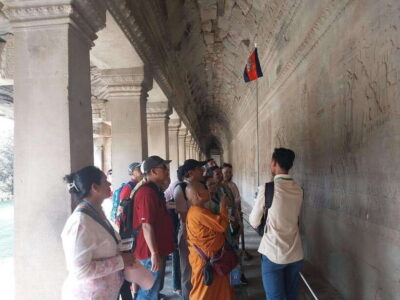
Angkor is not just a bunch of stone buildings. It is a whole planned world, with symbols, layout choices, and a story you can miss if you are just taking photos. A live guide in Spanish (with Portuguese and English also offered) is a big help because the temples look similar at first, then suddenly start to connect.
I like that this tour keeps the group small, capped at 9 people. That matters at places like the Bayon and Ta Phrom where crowds can slow you down and where you want to hear explanations without yelling over everyone.
The main drawback is simple: it is an 8-hour day. If you are sensitive to walking, heat, or long temple circuits, you will feel it, even if the schedule is well paced.
From Siem Reap hotel pickup to Angkor Thom’s South Gate
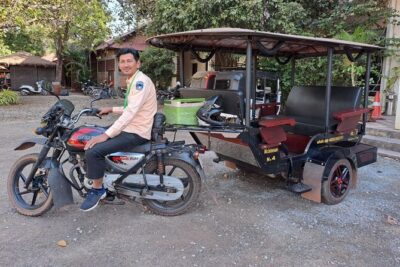
The day starts in the morning with hotel pickup in Siem Reap. From there, you are set up for a structured loop through Angkor’s core sights instead of trying to stitch together tuk-tuk stops on your own.
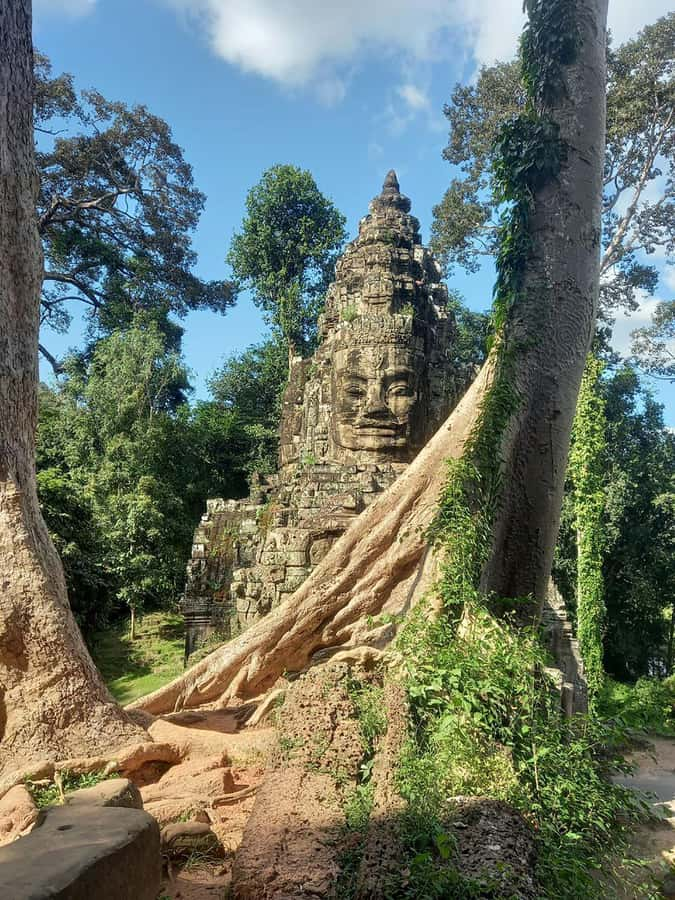
Your first major target is Angkor Thom, described as a fortified city that covers about 10 square kilometers. The tour then funnels you through the South Gate, a dramatic entry point reached via a causeway.
On that causeway, you will see statues arranged in myth-style lines: demons and gods on both sides, and each side pairing with giant naga. This is one of those details that sounds fancy until you see it. With a guide’s context, you start noticing the repeating iconography instead of just scanning for the next temple photo.
Practical note: the tour provider lists GPS/map and a pen among the items to bring. Even if you do not use everything, it is a good sign they expect you to be actively following along and taking notes.
Bayon Temple faces: the kind of carvings that change your focus
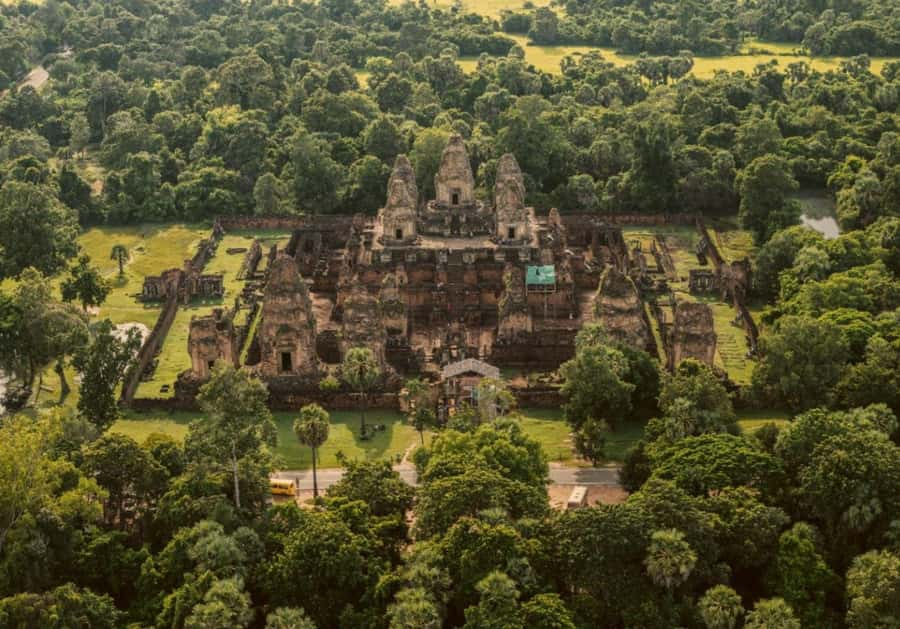
After Angkor Thom’s gate entry, the next stop is Bayon Temple, famous for its carved faces. The highlight here is not one single view, it is the way the faces show up repeatedly as you move through the site.
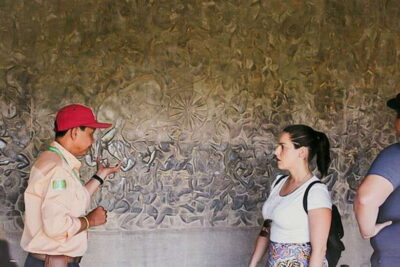
This is where a guide can make a real difference. Bayon can feel confusing if you only know it as the temple with faces. With interpretation, you start reading the faces as part of a larger visual program, tied to the surrounding design.
You will also have a chance to get your bearings because the tour does not jump straight from the gate to Angkor Wat. It builds momentum in a logical sequence, so you are not mentally tired before the big names.
If you are traveling with people who struggle to keep up, this is also a decent choice because the stop is recognizable even if you only spend part of the time looking carefully. The faces are hard to miss.
Terrace of the Elephants and Terrace of the Leper Kings
Next come two named terraces: the Terrace of the Elephants and the Terrace of the Leper Kings. Even if the names are what grab you, what you should watch for is how the sculpture work frames the spaces around it.
The Terrace of the Elephants is called that for a reason, and you will see how the theme affects the way you walk and what you notice first. The important part is that terraces like these sit at the crossroads of ceremonies and power. They are built to be seen, not just passed through.
Then you shift to the Terrace of the Leper Kings, which brings a completely different mood. The name is striking, and with a guide, you will likely get more clarity about what you are seeing and why it was depicted that way.
A possible consideration here is time management. Terraces often reward slow looking, but a day tour has to fit multiple sites. If you want to linger, plan to focus on one or two areas of detail rather than trying to read everything at once.
More days made easy with a guide
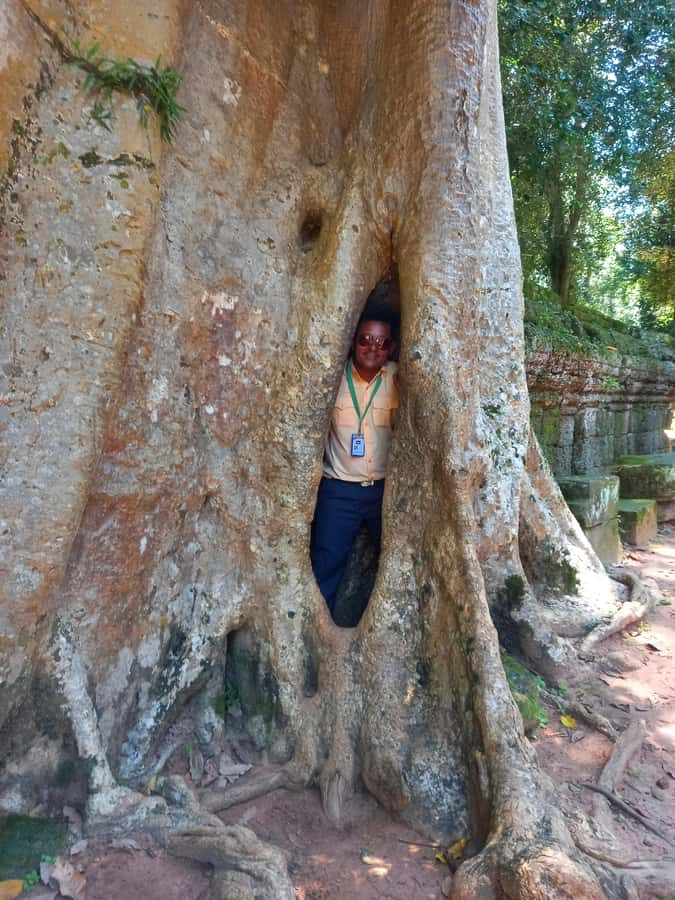
Ta Phrom in the jungle: when the stones feel alive
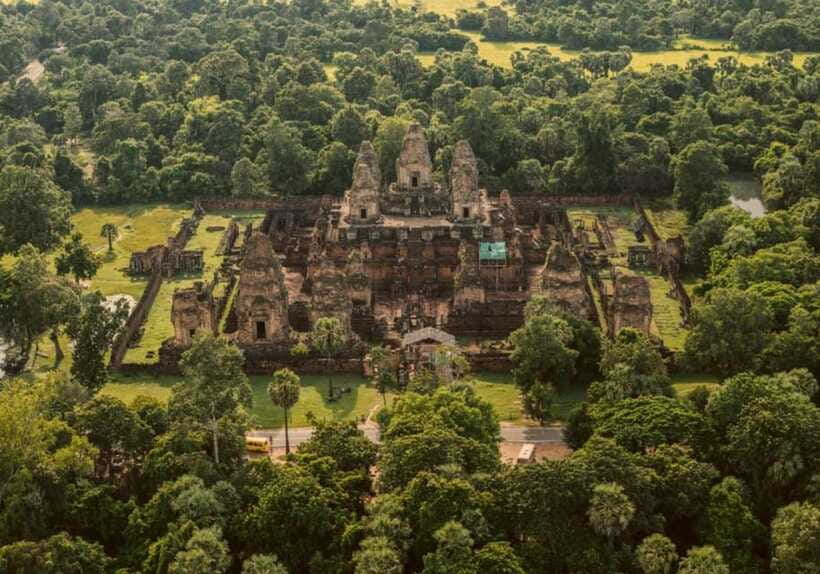
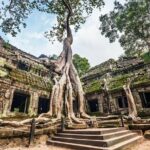
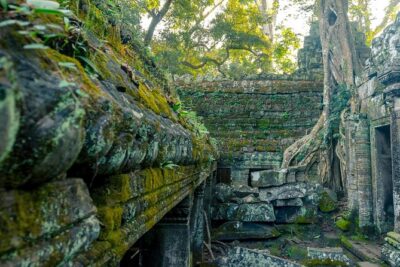
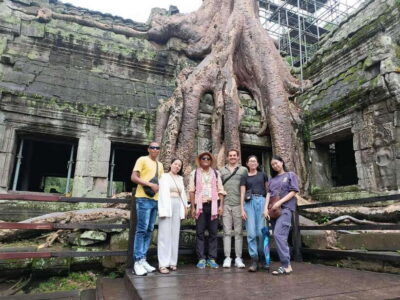
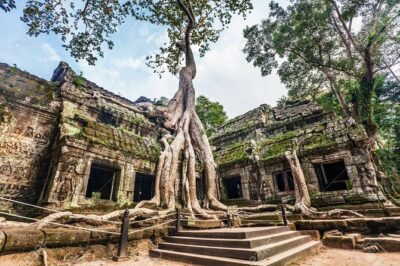
After the terraces, the tour heads to Ta Phrom, described as a beautiful temple in the jungle that has remained relatively untouched since it was discovered. That wording matters because Ta Phrom is the one stop on this route where the environment can feel like part of the monument.
Here, the experience flips from structured layouts to something more atmospheric. Roots and growth can change how you approach the walls, and they can make the carvings look both ancient and oddly current.
I like Ta Phrom on this kind of schedule because it breaks the rhythm. You go from gate entry, then face-heavy Bayon, then terrace sculpture, and then you land in a temple that feels like it is still being revealed.
One practical tip from the packing list: bring a jacket even if you think it will be warm. Weather in Siem Reap can shift, and temple shade plus morning air can make “light layer” feel like “smart layer.”
Also, there is no mention of pets being allowed, so keep it straightforward and leave animals at home.
Angkor Wat in the afternoon: the scale is the story
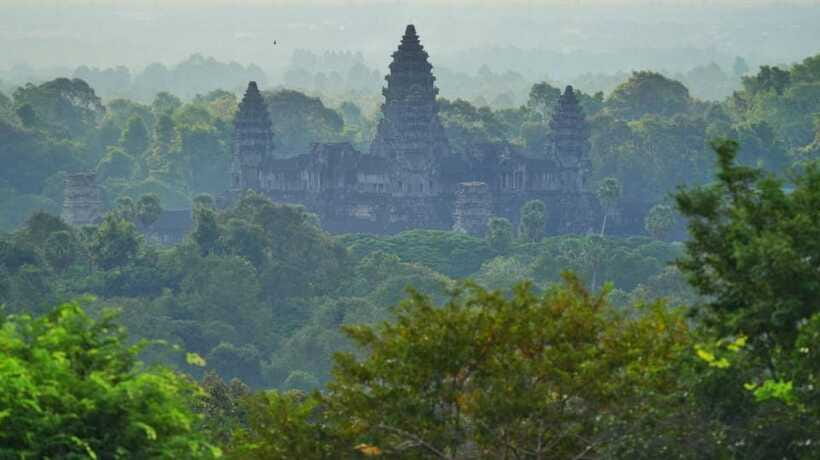
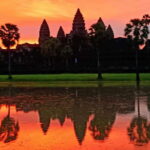
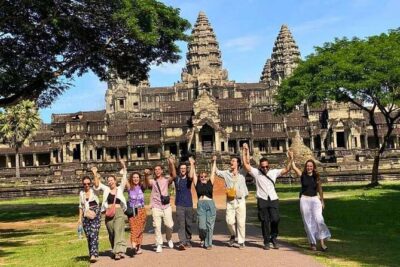
The afternoon is reserved for Angkor Wat, the most famous temple on the Angkor plain. The tour highlights it as a lost-city feeling in the Cambodian jungle, and it is hard to argue after you have seen the sheer size and layout in real life.
This complex covers 81 hectares, and the description compares it to the Imperial Palace in Beijing. That comparison helps you understand scale in a way that simple square meters do not. Even when you only see parts of it on a day tour, you grasp quickly that this place was built for an entire system, not one moment.
Angkor Wat is also praised for composition, balance, proportions, and sculptural detail. What this means for you: you will spend less time wondering what to look at and more time noticing how the space leads your eye. Symmetry and repeating lines can feel calming if you let the guide slow you down mentally.
The big-picture value here is that you finish the day with the site most people dream about. By the time you arrive, you have already learned the “language” of Angkor through earlier stops. That makes Angkor Wat more satisfying, not just more impressive.
Value and what $50 buys you in a full day
At $50 per person for an 8-hour shared tour, you are paying for two things: access to the route and the explanation that keeps you from feeling lost. The sites are the real cost driver, but the guide and small group size are what turn the day from stone sightseeing into something closer to understanding.
The small group limit of 9 helps the value. You spend less time waiting around, and you have a better shot at asking questions when you see something specific, like the faces at Bayon or the carved scenes on the terraces.
Price is also easier to justify when you know the language options. With Spanish, Portuguese, and English supported, it is not as easy to end up with a guide your party cannot follow. In at least one recent Spanish booking, the guide name Sem was singled out for explaining things in detail, and that is exactly what you want from this kind of day.
Two quick comfort notes based on the provided info: you should drink water, and you should be ready for a long walking day. The tour does not list meals, so build your day around that reality and plan your own breaks.
Who this tour is best for
This tour is a strong fit if you want the biggest Angkor hits in one day, with live interpretation in Spanish. It is also a good choice for friends or couples who prefer structure, not the stress of coordinating each temple visit.
It is less ideal if you hate walking circuits or if you need a slower pace. The duration and the number of stops mean you will be moving most of the day.
Weight limit matters too. The tour is listed as not suitable for people over 331 lbs (150 kg), so check that before you book.
If your travel group includes different language speakers, the guide’s multilingual options are a real advantage. You can stay together instead of splitting up.
Should you book this Angkor Thom and Angkor Wat day tour?
I would book it if you want a focused, guided loop that hits Angkor Thom, Bayon, Ta Phrom, and Angkor Wat without requiring planning between stops. The small-group cap and the Spanish-language support are the main reasons, and the fact that at least one guide, Sem, was praised for detailed explanations is a good sign you will not just get directions.
I would think twice if you are looking for a relaxed, unstructured day where you can wander for hours without a schedule. This is an efficient circuit built for seeing the essentials in one sitting.
If you decide to go, pack the basics the tour suggests: drinks, a jacket, and a GPS/map. Also, bring a pen if you like taking notes, because temple names and details can blur once you hit the next stop.
FAQ
How long is the Angkor Temple shared day tour?
The tour duration is listed as 8 hours.
Where does the tour start?
It includes hotel pickup in Siem Reap in the morning.
What temples are included in the itinerary?
The tour includes Angkor Thom (including the South Gate), Bayon Temple, the Terrace of the Elephants, the Terrace of the Leper Kings, Ta Phrom, and Angkor Wat.
Is the tour private or shared?
It is a shared day tour.
How big is the group?
The group is limited to 9 participants.
What languages does the live guide speak?
The live tour guide is listed as available in Spanish, Portuguese, and English.
What should I bring?
The tour suggests bringing drinks, a jacket, GPS/map, and a pen, plus internet access.
Are pets allowed?
No pets are allowed.
Is there a weight limit?
Yes. It is not suitable for people over 331 lbs (150 kg).
Can I cancel and get a refund?
You can cancel up to 24 hours in advance for a full refund.
More Siem Reap Tours to Compare
- Angkor Wat Sunrise or Sunset Tour with Guide from Siem Reap
★ 5.0 · 12,109 reviews - Siem Reap: Angkor Wat: Small-Group Sunrise or Sunset Tour
★ 5.0 · 9,444 reviews - From Siem Reap: Kampong Phluk Floating Village Tour by Boat
★ 4.9 · 6,979 reviews - Sunset tour of Kampong Phluk stilts home village on the Tonle Sap
★ 5.0 · 4,865 reviews - Siem Reap: Angkor Wat 2-Day Tour with Sunrise and Sunset
★ 4.9 · 4,429 reviews
More Tour Reviews in Siem Reap
- Angkor Wat Sunrise or Sunset Tour with Guide from Siem Reap
★ 5.0 · 12,109 reviews - Siem Reap: Angkor Wat: Small-Group Sunrise or Sunset Tour
★ 5.0 · 9,444 reviews - From Siem Reap: Kampong Phluk Floating Village Tour by Boat
★ 4.9 · 6,979 reviews - Sunset tour of Kampong Phluk stilts home village on the Tonle Sap
★ 5.0 · 4,865 reviews - Siem Reap: Angkor Wat 2-Day Tour with Sunrise and Sunset
★ 4.9 · 4,429 reviews
More Temple Circuits Around Siem Reap
- Angkor Wat Sunrise or Sunset Tour with Guide from Siem Reap
★ 5.0 · 12,109 reviews - Siem Reap: Angkor Wat: Small-Group Sunrise or Sunset Tour
★ 5.0 · 9,444 reviews - Siem Reap: Angkor Wat 2-Day Tour with Sunrise and Sunset
★ 4.9 · 4,429 reviews - Siem Reap: Full-Day Angkor Wat Guided Tour with Sunset
★ 4.9 · 3,803 reviews - Angkor Wat Sunrise tour with Small – Group and Guide tours
★ 5.0 · 3,655 reviews
Just Added: Fresh Siem Reap Tour Reviews

Angkor Temple Tours, compared.
 ★ 5.0Angkor Wat Sunrise or Sunset Tour with Guide from Siem ReapFrom $1812,109 reviews
 ★ 5.0Angkor Wat: Small-Group Sunrise or Sunset TourFrom $159,444 reviews
 ★ 4.9Angkor Wat 2-Day Tour with Sunrise and SunsetFrom $344,429 reviews
 ★ 4.9Full-Day Angkor Wat Guided Tour with SunsetFrom $153,803 reviews
 ★ 5.0Angkor Wat Sunrise tour with Small – Group and Guide toursFrom $143,655 reviews
 ★ 5.0Angkor Wat Highlights and Sunrise Guided Tour from Siem ReapFrom $233,213 reviews
 ★ 5.0Angkor Wat Sunset Small Group Tour with Lunch IncludedFrom $203,059 reviews
 ★ 5.0Full-Day Angkor Wat Sunrise Private Tour with Guide from Siem ReapFrom $602,920 reviews