
Reviewed · ANGKOR WAT TEMPLE TOURS
Private Tour: Siem Reap Full Day Tour With Angkor Wat Banteay Srei Bayon Temple and Ta Prohm
Angkor in a single day can work, if planned right. I especially like the way the day pairs a real English-speaking guide with plenty of time to question the carvings and layout of each temple. I also like the convenience of hotel pickup and drop-off, plus an air-conditioned private vehicle. The main drawback is that lunch is not included, so you’ll need to budget for food once the morning temples are done.
This is a great fit if you want the classic Angkor lineup without the stress of self-planning. With a full day at a tight but manageable 8 hours, you’ll see the big symbols fast, then get the context that makes those stones feel like more than photos.
Key Highlights You Will Care About
- One-day Angkor route that covers Angkor Wat, Banteay Srei, Bayon, and Ta Prohm
- All entrance fees included so you can focus on the sites, not ticket math
- English-speaking local guide who explains what you’re looking at and helps with photos
- Private, air-conditioned vehicle plus hotel pickup and drop-off in Siem Reap city
- Mobile ticket for easier access on the day
Other ways to walk the great temple
- Angkor Wat Sunrise or Sunset Tour with Guide from Siem Reap★ 5.0 · 12,109 reviews
- Siem Reap: Angkor Wat: Small-Group Sunrise or Sunset Tour★ 5.0 · 9,444 reviews
- Siem Reap: Angkor Wat 2-Day Tour with Sunrise and Sunset★ 4.9 · 4,429 reviews
- Siem Reap: Full-Day Angkor Wat Guided Tour with Sunset★ 4.9 · 3,803 reviews
The Value Beat: What $178 Buys You in Angkor
At $178 per person for an 8-hour day, the value comes from fewer surprises. You’re not just paying for transport and a name on a schedule. Entrance fees are included, you have an English-speaking local guide, and you get a private air-conditioned vehicle with hotel pickup and drop-off in Siem Reap city.
That matters in Angkor because the day gets complicated fast. Temples are spread out, roads can add time, and the heat can turn walking into a chore if you do it solo. Paying for a structured route is one of the smartest ways to protect your energy for the sights that truly demand attention.
This is also a private tour, meaning it’s only your group. If you’re traveling as a couple, a small family, or two or three friends, you get flexibility to ask questions and move at a pace that fits you, without feeling like you’re stuck behind a long line of strangers.
Your Morning Start From Siem Reap City to Angkor Wat
The day begins at 9:00 am, with pickup from hotels in the Siem Reap city area. The itinerary’s first stop is listed around the Park Hyatt Siem Reap area, which is a helpful reference point if you like knowing where you’ll be collected.
Then the route heads straight to Angkor Wat, the biggest and most famous temple complex in the region. The tour schedules about 1 hour at this first stop, with admission ticket included. That hour is not just about standing in front of the main view. It’s enough time to understand the place, then choose a few details to return to rather than trying to see everything.
If you’re the type who likes to know why a temple was built and how it was designed, this timing works well. The guide can explain the logic of the approach, the walls, and the carved story panels, and you can ask questions while the site is still fresh in front of you.
Angkor Wat: 3.6 km Walls, Big Empty Space, and Bas Reliefs
Angkor Wat isn’t just iconic because it’s famous. It’s iconic because the design is clear and intentional: a moat and an outer wall that stretches 3.6 kilometers, creating a strong boundary between the everyday world and the sacred interior.
One of the smartest parts of a guided stop here is realizing what you’re seeing when you notice that there is a long path leading toward the main temple and a large area of empty space inside the walls. Guides can point out that this open layout is part of the experience, not wasted space. It helps you understand how processional movement and sightlines were planned.
You’ll also get time to look at the bas reliefs along the sides of the temple. These carved panels are where many visitors slow down, because that’s where the stories and details show up. With an English-speaking guide, you’re not stuck guessing what each scene might represent. If you like photos, you can also ask for help on framing, especially if you are traveling on your own.
A practical note: 1 hour can feel quick if you stop to read every carving. But with a guide, you can prioritize the details that actually reward your time.
Banteay Srei: Why This Temple Gets a Reputation
After Angkor Wat, the next move is Banteay Srei. This temple is one of the most beautiful in the Angkor region, and it even gives its name to the surrounding district. That connection is more than trivia. It hints that the place mattered locally, not only as a famous stop on the overall Angkor circuit.
The tour schedules about 1 hour here, with admission ticket included. In that time, it’s easier to appreciate Banteay Srei’s style because you can focus on the look and feel of the carvings without being rushed into the next location every few minutes.
The other reason Banteay Srei is a strong choice for a one-day plan is contrast. Compared with Angkor Wat’s scale, Banteay Srei often feels more intimate and detailed, which makes your eyes reset. The guide can help you see the pattern of ornamentation and explain what you’re looking at, so the temple doesn’t blur into a general mass of stone.
Back through the south gate to Bayon


Bayon Temple: A State Temple With Strong Visuals
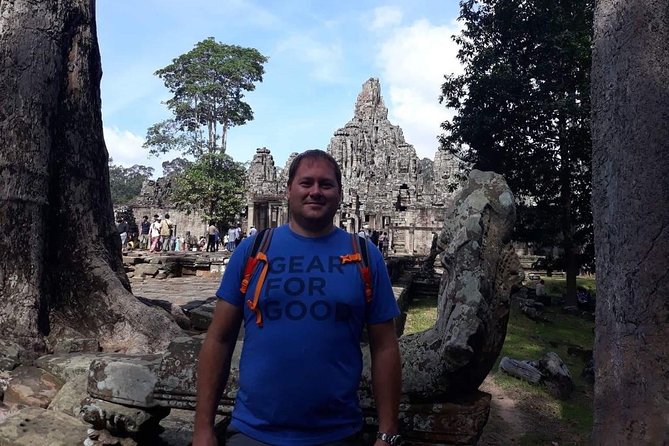
From Banteay Srei, you move to Bayon Temple. Bayon is described as a richly decorated Khmer temple at Angkor, built in the late 12th or early 13th century as the official state temple of the Mahayana Buddhists, tied to the reign of that era.
This stop is scheduled for about 1 hour, with admission included. Bayon is the kind of place where you benefit from a guide because your attention can scatter. A good guide helps you look past the first big impression and notice how the temple’s design communicates power, belief, and authority.
The timing also helps. You’ve already seen the grand walls and procession layout of Angkor Wat. You’ve already shifted into finer detail at Banteay Srei. Bayon becomes the moment where both styles connect, so you can feel the overall story of Angkor rather than treating each temple as a separate postcard.
After Lunch at Your Own Cost: Ta Prohm and the 1186 Story
Ta Prohm comes after lunch, and lunch is at your own cost. The itinerary keeps the visit around 1 hour, with admission ticket included.
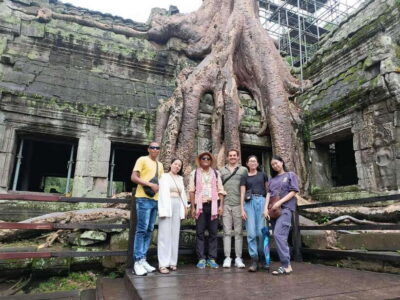
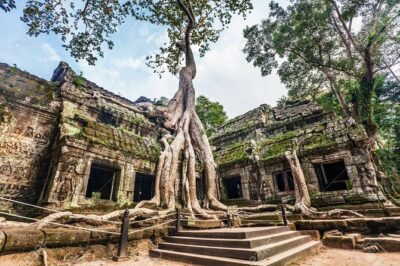
Ta Prohm is a Buddhist temple built by King Jayavarman VII in 1186. It was dedicated to the king’s mother, which gives the site an emotional layer beyond architecture. When you understand that dedication, the temple feels less like a dramatic ruin and more like a purposeful monument tied to a person and a family story.
Ta Prohm is also one of the most visually recognizable temples in the entire complex. If you care about how history, politics, and religion intersect, this is the stop that tends to click. But because lunch is not included, you’ll want to plan a simple meal break with enough time to reset your energy.
If you want to maximize your day, budget for lunch and avoid over-ordering snacks earlier. The structure of the day is temple-focused, so the lunch stop is more about keeping you moving than creating a long sit-down experience.
Private Guide Strength: Asking Better Questions at Every Stop
A good thing about this tour style is that it’s built around your questions. The guide’s job is not only to narrate, but to point out what matters while you’re standing in front of it.
In particular, the tour has featured guides like Mr. Thou and Mr. Sophorn, both praised for strong English and for explaining Cambodian culture and temple details. That kind of communication changes your experience at Angkor because you can ask follow-ups, not just listen to a monologue.
It’s also helpful if you are traveling alone. One of the practical benefits mentioned is guide support with photos, so you’re not stuck relying on luck for a decent shot at the main angles.
Timing Reality: Can You See It All Without Feeling Rushed?
The itinerary is built as a tight loop, but it’s not absurdly fast. Each major stop is about 1 hour, and the total day is about 8 hours. That design choice is smart because Angkor punishes over-ambition. If you try to do too much on your own, you end up spending your day negotiating logistics instead of enjoying the temples.
Still, you should be honest about your pace. If you want to read every bas relief panel line by line, you might feel compressed. If you prefer a guided “this is what to look for” approach and then time for your favorite details, this format usually works well.
The biggest scheduling consideration is lunch being on your own. It’s not a deal breaker, but it can slow you down if you end up searching for food or waiting too long at a place you don’t like.
Comfort and Getting Around: Why the Vehicle Matters
You get a private air-conditioned vehicle, which is not a luxury in Siem Reap. It’s what helps you survive a full day of temple walking and sun exposure without turning the afternoon into a misery contest.
Pickup and drop-off are included for hotels in Siem Reap city area. That saves time and keeps the day from feeling like a project. Instead of juggling tuk-tuk rides, finding meeting points, and trying to interpret which gate to use, you just meet at 9:00 am and let the schedule carry you.
The route is also set up for a smooth flow: Angkor Wat first, then Banteay Srei, then Bayon, then Ta Prohm after lunch. That sequence makes sense because it moves from the monumental, to detailed carvings, to strong visual statements, and ends with one of the most atmospheric sites.
Who This Tour Suits Best (and Who Might Rethink It)
This tour makes a lot of sense if you want the classic Angkor sights in one day and you like learning as you look. You’ll likely enjoy the experience most if you:
- Want a guided explanation of what you’re seeing, not just a map and a ticket
- Prefer convenience, including hotel pickup and drop-off
- Are okay with spending about 1 hour at each major temple
- Will budget for lunch since it’s not included
You might rethink the tour if you hate structured schedules. If you want long wandering time, fewer transitions, and the freedom to spend extra hours at one temple, a multi-day approach can feel better. But if you only have one day and want the core highlights, this plan is focused and efficient.
Should You Book This Siem Reap Full Day Angkor Tour?
If your goal is to see Angkor Wat, Banteay Srei, Bayon, and Ta Prohm in one day, and you want a guide who explains the carvings and the temple context, this tour is a strong choice. The value is in the package: entrance fees, English-speaking local guide, and private air-conditioned transport are all included.
I’d book it if you want structure and you appreciate learning while you’re there. I would pause only if you’re extremely detail-obsessed and know you need more than about an hour per temple, or if you really dislike paying extra for lunch during a tour.
FAQ
What time does the tour start?
The tour starts at 9:00 am.
How long is the Siem Reap full day Angkor tour?
The duration is about 8 hours.
Which temples are included on this tour?
The tour includes Angkor Wat, Banteay Srei, Bayon Temple, and Ta Prohm.
Is hotel pickup and drop-off included?
Yes. Pickup and drop-off are included for Siem Reap city area hotels.
Are entrance fees included?
Yes. All entrance fees are included, and admission tickets are listed as included at each stop.
Is lunch included in the price?
Lunch is not included. Food and drinks are listed as not included, and lunch is referenced as being at your own cost.
Is free cancellation available?
Yes. Free cancellation is available if you cancel up to 24 hours in advance for a full refund. If you cancel less than 24 hours before the start time, the amount paid will not be refunded.
Ta Prohm and the Roots
- Siem Reap Tour: Angkor Wat Sunrise, Bayon, Ta Prohm, Banteay Srei
★ 5.0 · 931 reviews - Angkor Wat Private Driver Tours to Angkor Wat Sunrise, Angkor Thom & Ta Prohm
★ 5.0 · 98 reviews - Private Temples Guided Tour (Angkor Wat, Ta Prom & Angkor Thom)
★ 5.0 · 75 reviews - One Full Day Private tour of Angkor Wat, Ta Prohm, Angkor Thom & Banteay Srie
★ 5.0 · 64 reviews - Siem Reap Private Day Tour: Angkor Wat Sunrise, Bayon & Ta Prohm
★ 5.0 · 48 reviews
Through Angkor Thom to Bayon
- Siem Reap Tour: Angkor Wat Sunrise, Bayon, Ta Prohm, Banteay Srei
★ 5.0 · 931 reviews - Angkor Wat Private Driver Tours to Angkor Wat Sunrise, Angkor Thom & Ta Prohm
★ 5.0 · 98 reviews - Angkor Wat Sunrise and Angkor Thom Sunset Tour
★ 5.0 · 89 reviews - Private Temples Guided Tour (Angkor Wat, Ta Prom & Angkor Thom)
★ 5.0 · 75 reviews - One Full Day Private tour of Angkor Wat, Ta Prohm, Angkor Thom & Banteay Srie
★ 5.0 · 64 reviews
Angkor Wat, a Few More Ways In
- Angkor Wat Sunrise or Sunset Tour with Guide from Siem Reap
★ 5.0 · 12,109 reviews - Siem Reap: Angkor Wat: Small-Group Sunrise or Sunset Tour
★ 5.0 · 9,444 reviews - Siem Reap: Angkor Wat 2-Day Tour with Sunrise and Sunset
★ 4.9 · 4,429 reviews - Siem Reap: Full-Day Angkor Wat Guided Tour with Sunset
★ 4.9 · 3,803 reviews - Angkor Wat Sunrise tour with Small – Group and Guide tours
★ 5.0 · 3,655 reviews
Just Added: Fresh Siem Reap Tour Reviews


Angkor Wat Temple Tours, compared.
 ★ 5.0Angkor Wat Sunrise or Sunset Tour with Guide from Siem ReapFrom $1812,109 reviews
 ★ 5.0Angkor Wat: Small-Group Sunrise or Sunset TourFrom $159,444 reviews
 ★ 4.9Angkor Wat 2-Day Tour with Sunrise and SunsetFrom $344,429 reviews
 ★ 4.9Full-Day Angkor Wat Guided Tour with SunsetFrom $153,803 reviews
 ★ 5.0Angkor Wat Sunrise tour with Small – Group and Guide toursFrom $143,655 reviews
 ★ 5.0Angkor Wat Highlights and Sunrise Guided Tour from Siem ReapFrom $233,213 reviews
 ★ 5.0Angkor Wat Sunset Small Group Tour with Lunch IncludedFrom $203,059 reviews
 ★ 5.0Full-Day Angkor Wat Sunrise Private Tour with Guide from Siem ReapFrom $602,920 reviews
Browse the lists this tour appears in