
Reviewed · ANGKOR WAT TEMPLE TOURS
Angkor Wat Sunrise & Ancient City Discovery
Waking up for sunrise at Angkor Wat is the hard part, not the ride. This 5:00 am tour mixes temple time with cycling time, so you get golden light, then you still have a full day’s worth of sights ahead of you. I like that your English-speaking guide (I’ve seen names like Azude Seng, Bobo, Vannarath, and Sihal in past groups) helps you read what you’re seeing, not just point at stone. I also really like that you’re not scrambling for food, since breakfast and lunch come with the tour.
One thing to plan for: the big temple pass is not included in the $70 price. Also, you’ll need to be comfortable riding a mountain bike on a mix of surfaces early in the morning.
Key things to know before you go
- Sunrise timing starts at 5:00 am, so you’re up early, but you’re also out while the light is still magic.
- Mountain bike and helmet are provided (listed as Giant or Trek), which keeps the trip simpler.
- Food and drinks are included, including breakfast, lunch, water, and fresh coconut juice.
- Max group size is 10, which usually makes photo stops and pacing feel more personal.
- You’ll hit more than just Angkor Wat, including Bayon, Preah Khan, Ta Nei, Ta Prohm, and Prasat Chrung.
- Guides focus on smart photo spots, with some effort to avoid the heaviest congestion.
Other ways to walk the great temple
- Angkor Wat Sunrise or Sunset Tour with Guide from Siem Reap★ 5.0 · 12,109 reviews
- Siem Reap: Angkor Wat: Small-Group Sunrise or Sunset Tour★ 5.0 · 9,444 reviews
- Siem Reap: Angkor Wat 2-Day Tour with Sunrise and Sunset★ 4.9 · 4,429 reviews
- Siem Reap: Full-Day Angkor Wat Guided Tour with Sunset★ 4.9 · 3,803 reviews
Sunrise first, then temples by bike, not by gridlocked traffic
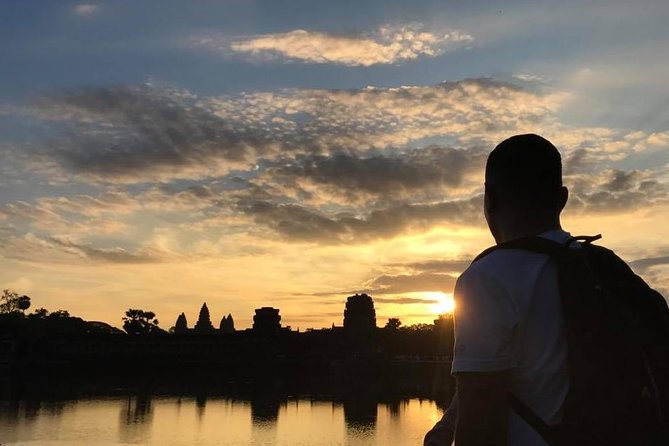
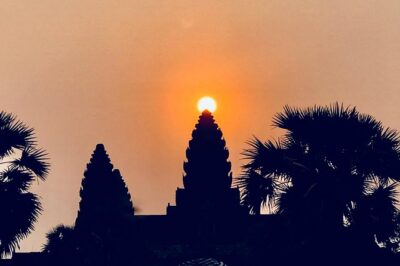
If you care about Angkor Wat but you hate doing everything at walking-speed, this is a strong match. The day starts when it is still dark, then the sunrise starts to spill across the horizon. You get that first look at the temple’s geometry and shadows before the rest of the day turns loud and crowded.
Then the tone changes fast: you swap the slow shuffle for a mountain bike. Instead of bouncing between far-apart sights with long waits, you pedal through forest trails and the temple area like it’s one connected outdoor museum. The result feels active, outdoorsy, and practical, while still being respectful of a place that is very much alive for Cambodian Buddhists.
The other reason I like this format is that you are not just ticking off one temple. You’re also looking at the wider Angkor “city” concept: gates, defensive walls, and temple clusters that feel like a system built for movement and ceremony.
The 5:00 am start: why early matters here
This tour begins at 5:00 am, which sounds brutal until you remember what you came for. Sunrise at Angkor Wat is not just about light. It is about vantage points, atmosphere, and having time to actually appreciate the carvings and layout.
After the sunrise portion, you’re left with plenty of time to keep going. The cycling part is scheduled so you can explore multiple temples in one go, rather than spending your only good daylight hours in transit. That matters in Siem Reap, where temple lines and heat can start to feel like part of the attraction.
If you dislike early mornings, be honest with yourself. This is a sunrise tour. You will be awake early either way, so plan for it like a mission: charge your camera the night before, set out water, and keep your morning gear simple.
What’s included in the $70 price, and what that means for you
On paper, $70 per person is just a number. In practice, it covers a lot of the daily friction that can make temple days stressful.
Here’s what you get:
- English-speaking tour guide
- Quality mountain bike and helmet (Giant or Trek listed)
- Breakfast and lunch
- Drinking water and fresh coconut juice
- Hotel pickup
This is the main value: you are not organizing the bike rental, you’re not negotiating food, and you’re not trying to figure out the route at pre-dawn hours. When guides like Azude Seng or Bobo are on the bike with you, you also get context as you move. That helps you understand what you are seeing in Bayon, Preah Khan, and the smaller temple stops, instead of treating them like random photo backdrops.
The included food also changes how you experience the day. You can ride without constantly searching for a quick snack or losing time to lunch lines. For a 9-hour outing, that time protection is worth something.
One small detail to watch: the tour notes list hotel pickup as included, but hotel drop-off is listed as not included. The summary also mentions round-trip hotel transfers. If drop-off matters to you, confirm what happens at the end of your specific tour.
Temple pass costs: the extra $37 you should budget
The temple pass is not included, and the listed price is $37 for 1 day entry. That means the realistic starting point for your day is closer to $107 total per person once you add the pass.
You might be tempted to treat that as a nuisance fee. But it’s actually a standard Angkor reality. The pass is what lets you access the temple complex sites included in your day. The smart move is to budget it early so you do not feel surprised on pickup day.
If you’re comparing options, do your math with the pass included. A tour that looks cheaper can turn expensive once you add entry, and this is one of those cases where the pass can be the biggest extra line item.
Chasing the light? More dawn and dusk runs
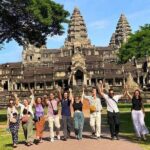
Your ride-through temples plan: Angkor Wat to Angkor Thom gates and beyond
The day is built like a sequence of different kinds of looking. First you look at Angkor Wat as architecture. Then you look at it as a place with movement and paths. Then you shift to other temples that each have a different feel.
Angkor Wat sunrise, then time inside the complex
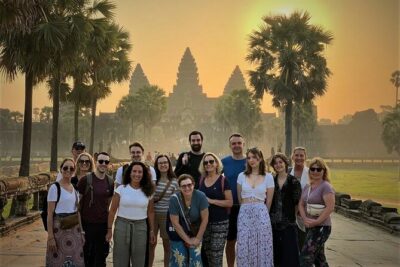
The tour begins with sunrise views over Angkor Wat. You then have time to stroll through temple chambers and learn the site’s history as you go. This part matters because it sets your mental map. Once you understand the overall layout, the rest of the day feels less chaotic and more connected.
South gate of Angkor Thom, a defensive-wall moment
After that, you move into the broader Angkor city area, including the South gate of Angkor Thom. This is not just a gate for photos. It’s part of a defensive wall story, and seeing it from the right angles makes it feel like a real fortress boundary, not a decorative entrance.
Prasat Chrung, plus a climb for the view
You’ll also get a more energetic stop at Prasat Chrung, where the tour includes climbing up and exploring the protection wall area to see the view. If you like viewpoints and you do not mind some stairs, this is one of the best payoff moments of the day.
West gate and North gate of Angkor Thom
You’re also set up to see the West gate and North gate of Angkor Thom. These stops are valuable because they show different sections of the same big defensive concept. Seeing multiple gates helps your brain understand the system as a whole.
The temple cluster ride: Bayon, Preah Khan, Ta Nei, and Ta Prohm
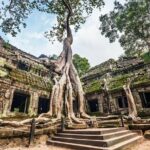
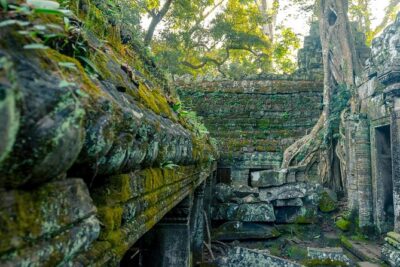
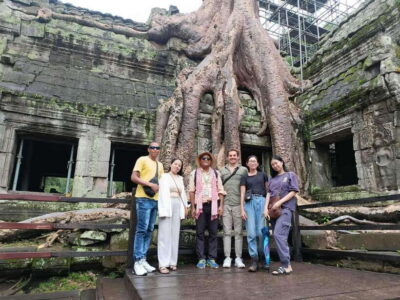
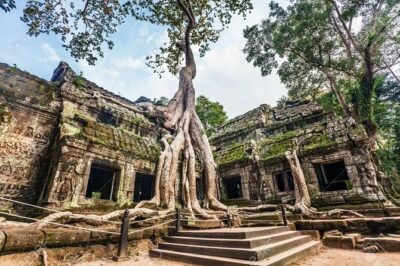
The tour’s cycling route also takes you to major temples beyond the gates, including Bayon, Preah Khan, Ta Nei, and Ta Prohm. Each one has its own personality. Bayon tends to draw you in visually. Preah Khan feels more expansive and atmospheric. Ta Nei and Ta Prohm bring you closer to the “temple meets forest” vibe, where trees and stone share the same frame.
If your goal is to experience more of Angkor without spending your day walking between distant points, this is the key advantage: you’re not limited to one corner.
Riding reality: what the bike trails feel like, and how the guides pace you
This is not a casual stroll with a bike parked nearby. It’s an active cycling day, and the route includes different textures under your tires. One past group description highlighted a mix that can include asphalt, dirt roads, elevated trails, and even single-track style sections.
That’s good news if you like adventure and moving through scenery. It’s less ideal if you want a fully smooth, paved ride. The good part is that you have a guide and a group size capped at 10, which usually makes it easier to slow down for tricky bits and regroup for photos.
The best thing I’ve learned from the guide-focused feedback is that pacing is flexible. People consistently mention guides steering toward good photo angles and timing sunrise spots carefully to avoid the heaviest congestion. That means you’re not just following a script, you’re being helped to get the best outcomes.
Also, wearing the helmet is not just for safety. It signals that the day takes riding seriously, so expect proper handling, stop-and-go moments, and a bit of morning chill. Bring a camera strap you can trust.
Food, water, and coconut juice: small inclusions that keep the day enjoyable
This tour covers more than just sightseeing. It takes care of your energy.
You get breakfast before or around the early part of the day, then lunch after the morning temples and cycling stretches. You also receive water and fresh coconut juice, which is practical in Siem Reap heat.
These inclusions matter because Angkor days can drain you fast. When you’re riding and climbing, you burn energy earlier than you think. A tour that forgets food forces you to stop at the wrong times, and that can ruin the rhythm. Here, you can keep your focus on the temples.
If you have dietary needs, the tour info asks you to advise them at booking. That’s important, and it’s worth doing early so the team can plan properly.
Dress code and etiquette: what to wear so you feel respectful and comfortable
Angkor is an active spiritual site. Cambodian Buddhists and local citizens worship there daily. That means dress rules are not optional theater. If you show up casually dressed, you might have issues entering certain palace areas.
The guidance is clear:
- Shorts and skirts above the knee are prohibited.
- Bare shoulders are prohibited in sacred palace areas.
- Respectful dress is strongly encouraged.
So plan on clothing that covers your knees and shoulders. Light fabrics are your friend. If you’re riding a bike, also think about how your clothes will stay comfortable when you’re hot and moving.
This is one of the easiest ways to make your day better. The more relaxed you are about entry rules, the more you can enjoy sunrise and the riding parts without awkward stops.
Who this tour fits well, and who should reconsider
This tour is listed as suitable for most travelers, and the max group size is small, which helps. But it still hinges on one main requirement: you’ll be cycling and you’ll be up early.
You’ll likely love it if:
- You want sunrise at Angkor Wat plus multiple temples in one day
- You enjoy biking and you don’t mind mixed surfaces
- You like guides who give context as you move, and you want help finding good photo angles
- You prefer a structured day with food handled (breakfast, lunch, water, coconut juice)
You might think twice if:
- You hate waking up at 5:00 am
- You prefer all walking, or you are not comfortable with the idea of a mountain bike day
- You want certainty about hotel drop-off and end-of-day location, since the details list pickup included but not drop-off
The real value check: should you choose this over other Angkor options?
Here’s how I’d decide based on what you want from your Angkor day.
Choose this tour if you want a day that feels like movement, not just waiting. The included bike, helmet, and food remove big hassles. The sunrise element gives your photos and first impressions a strong start. Then the cycling sequence lets you cover a lot of temple ground without feeling like you spent the day stuck in transit.
Skip it or look for a different format if you want a calmer, mostly walking day with less physical demand. Also, if your schedule is tight at the end of the day, double-check what happens after your hotel pickup, since drop-off is not clearly included in the details.
Should you book this Angkor Wat Sunrise & Ancient City Discovery tour?
Yes, if you want a sunrise temple experience and you like the idea of seeing Angkor by bike through gates, walls, and a temple circuit. The best reasons to book are the early-start structure, the small group size, and the practical inclusions like bike plus helmet and breakfast and lunch.
Do one extra bit of prep: budget the $37 1-day temple pass, and dress for sacred-site rules (shoulders covered, knees covered). If you do that, the day becomes a smooth combo of sunrise magic and real exploration on two wheels.
More Temple Circuits Around Siem Reap
- Angkor Wat Sunrise or Sunset Tour with Guide from Siem Reap
★ 5.0 · 12,109 reviews - Siem Reap: Angkor Wat: Small-Group Sunrise or Sunset Tour
★ 5.0 · 9,444 reviews - Siem Reap: Angkor Wat 2-Day Tour with Sunrise and Sunset
★ 4.9 · 4,429 reviews - Siem Reap: Full-Day Angkor Wat Guided Tour with Sunset
★ 4.9 · 3,803 reviews - Angkor Wat Sunrise tour with Small – Group and Guide tours
★ 5.0 · 3,655 reviews
Dawn and Dusk Over Angkor
- Angkor Wat Sunrise or Sunset Tour with Guide from Siem Reap
★ 5.0 · 12,109 reviews - Siem Reap: Angkor Wat: Small-Group Sunrise or Sunset Tour
★ 5.0 · 9,444 reviews - Sunset tour of Kampong Phluk stilts home village on the Tonle Sap
★ 5.0 · 4,865 reviews - Siem Reap: Angkor Wat 2-Day Tour with Sunrise and Sunset
★ 4.9 · 4,429 reviews - Siem Reap: Full-Day Angkor Wat Guided Tour with Sunset
★ 4.9 · 3,803 reviews
Angkor Wat, a Few More Ways In
- Angkor Wat Sunrise or Sunset Tour with Guide from Siem Reap
★ 5.0 · 12,109 reviews - Siem Reap: Angkor Wat: Small-Group Sunrise or Sunset Tour
★ 5.0 · 9,444 reviews - Siem Reap: Angkor Wat 2-Day Tour with Sunrise and Sunset
★ 4.9 · 4,429 reviews - Siem Reap: Full-Day Angkor Wat Guided Tour with Sunset
★ 4.9 · 3,803 reviews - Angkor Wat Sunrise tour with Small – Group and Guide tours
★ 5.0 · 3,655 reviews
Just Added: Fresh Siem Reap Tour Reviews
Angkor Wat Temple Tours, compared.
 ★ 5.0Angkor Wat Sunrise or Sunset Tour with Guide from Siem ReapFrom $1812,109 reviews
 ★ 5.0Angkor Wat: Small-Group Sunrise or Sunset TourFrom $159,444 reviews
 ★ 4.9Angkor Wat 2-Day Tour with Sunrise and SunsetFrom $344,429 reviews
 ★ 4.9Full-Day Angkor Wat Guided Tour with SunsetFrom $153,803 reviews
 ★ 5.0Angkor Wat Sunrise tour with Small – Group and Guide toursFrom $143,655 reviews
 ★ 5.0Angkor Wat Highlights and Sunrise Guided Tour from Siem ReapFrom $233,213 reviews
 ★ 5.0Angkor Wat Sunset Small Group Tour with Lunch IncludedFrom $203,059 reviews
 ★ 5.0Full-Day Angkor Wat Sunrise Private Tour with Guide from Siem ReapFrom $602,920 reviews
Browse the lists this tour appears in