
Angkor Wat plus Bayon faces is a great one-day hit. What I like most is the local expert guide who makes the stonework make sense, and I also like how the route connects the big set pieces without feeling like a stampede. One thing to consider is the temple fee is not included, and you still need to cover knees and shoulders, even on a long, hot day.
This is a half-day style tour, about 5 to 7 hours, built around the “small circuit” flow: Angkor Wat, then Angkor Thom South Gate and Bayon, and finally Ta Prohm. You get hotel pickup and drop-off, an air-conditioned car, plus cold towels and drinking water, so you start strong and stay sane between sites.
If you want to see the highlights but still keep room to breathe, this works well. Still, bring comfortable shoes and plan for walking time inside big temple complexes, because even when you are moving by car between stops, you will spend real hours on your feet.
Key things to know before you go
- Dan-style storytelling: The guide Dan is praised for clear stories about Cambodian history, politics, religion, and the carvings.
- Angkor Wat inside and out: You do more than look from the outside, which helps you understand what you are seeing.
- Angkor Thom South Gate quick orientation: You get the names of the five gates and the city scale early, then head straight to Bayon.
- Bayon faces with context: The famous smiling faces are shown along with how and why the temple was built.
- Ta Prohm, the tree temple mood: You see the living-with-ruins look that makes this site instantly recognizable.
- Value depends on the temple fees: Your $45 base price does not include the $37 temple fee per person.
Other ways to walk the great temple
- Angkor Wat Sunrise or Sunset Tour with Guide from Siem Reap★ 5.0 · 12,109 reviews
- Siem Reap: Angkor Wat: Small-Group Sunrise or Sunset Tour★ 5.0 · 9,444 reviews
- Siem Reap: Angkor Wat 2-Day Tour with Sunrise and Sunset★ 4.9 · 4,429 reviews
- Siem Reap: Full-Day Angkor Wat Guided Tour with Sunset★ 4.9 · 3,803 reviews
The small-circuit plan that hits the right temples
In Siem Reap, everyone talks about the “big” days. This tour is a smarter version of that idea. You focus on three headline temples, then add a small bonus temple stop if you have energy, all within a realistic half-day time window.
The main win here is pacing. Angkor Wat is enormous and will take your attention span whether you like history or just like great architecture. Then you shift to Angkor Thom and Bayon, where your eyes can rest on the faces and layered structures. After that, Ta Prohm gives you a different feel, more atmospheric and visual, with the well-known tree-and-stone look.
Because you are doing fewer major temples than some all-day loops, you can actually absorb what the guide points out. You are not only collecting photos, you are getting a mental map of how the sites connect.
Angkor Wat: huge scale, real symbolism, and a guided walkthrough
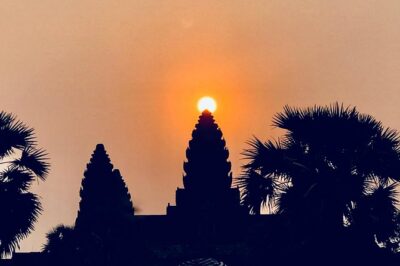
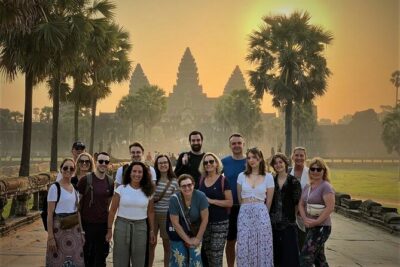
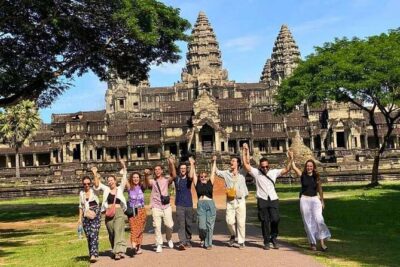
Angkor Wat is the reason many people plan Siem Reap in the first place. The temple complex was built between 1113 and 1150 AD by King Suryavarman II, and its scale is not subtle: it measures about 330 meters by 260 meters. It has three levels and five main towers, and it became Cambodia’s national symbol, even showing up on the national flag.
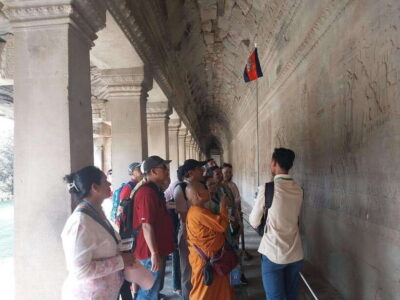
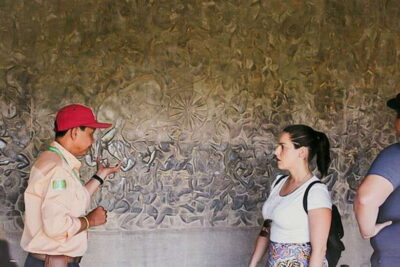
On this tour, you see Angkor Wat from the outside and also go inside, with a local guide explaining what you are looking at. That matters, because from the perimeter, it is easy to think it is just one big view. Inside, the details help you understand the design logic and why this site became so central to Cambodian identity.
A practical note: Angkor Wat can be bright and busy. Even with air-conditioned transport between stops, you will be exposed while you walk and wait for guide commentary. Wear a hat if you use one, bring water habits you can stick to, and keep your shoulders and knees covered when you enter.
Angkor Thom South Gate (Tonle Oum): a fast history primer before Bayon
After Angkor Wat, the tour heads to Angkor Thom and stops at the South Gate, also called Tonle Oum. This is a short stop, about 30 minutes, but it is designed like a quick orientation so Bayon lands better.
You also learn some useful city geometry. Angkor Thom is described as a square city with gates on multiple sides, and each side measures about 3 kilometers. You are told the five gates by name: South Gate, Ghost Gate (Gate of the Dead), Victory Gate, Dei Chhnang Gate (North Gate), and Killing Gate.
That might sound like trivia, but it actually helps your eyes. When you later see Bayon within the larger city story, the guide can connect the symbolism and layout to the temple’s role. It is the kind of small setup that makes the next stop feel less random.
Bayon Temple: the faces hit harder when you know what you’re seeing
Bayon is where the tour’s energy shifts from scale to expression. You visit Bayon for about 1 hour, seeing it from outside and also inside, with the guide explaining the history and religious meaning behind the site.
The standout feature is the famous faces, and yes, they really are as attention-grabbing as the photos make them seem. But the best part of a guided visit is that the faces become more than decoration. The guide helps you connect them to the religious forces and the cultural ideas that shaped temple building.
You will likely notice carvings and architectural rhythms while you are walking, and a good guide can point out what to look for instead of leaving you with only the big visual headline. In the praised experience from this tour, Dan is highlighted for exactly that, storytelling that ties Cambodian history, cultural and political context, and religion to what’s carved in stone.
If you care about meaning, this is the stop that delivers it. If you are more of a photo person, you still benefit, because understanding the site makes you frame your shots differently and spend time in the right areas.
Back through the south gate to Bayon


Ta Prohm: the tree temple experience, less rigid and more atmospheric
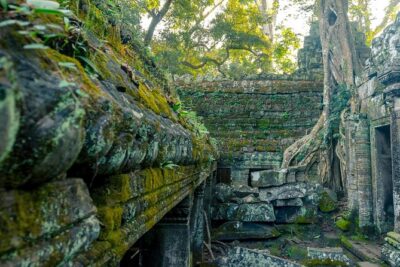
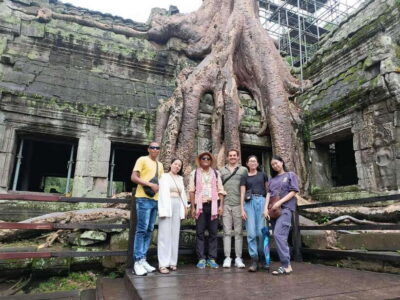
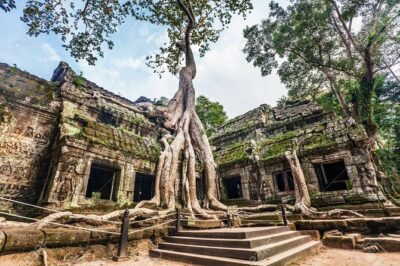
Ta Prohm is the final major temple on the tour, with about 1 hour on site. It is known as the tree temple, and that name is not just marketing. The visual energy here comes from how vegetation and stone share the same space, creating a feeling that the temple is suspended between past and present.
The tour includes outside views and time inside, guided again. That outside to inside flow is helpful at Ta Prohm because the most famous images tend to be outside perspectives. Once you go in, you can see how the layout supports movement through corridors and courtyards, and how the stonework holds up under the plant growth you see.
Ta Prohm is also a good “cool-down” in terms of intensity. Angkor Wat and Bayon are monumental and dense with detail. Ta Prohm feels more like a scene you step into, with a mood that is easier to experience without feeling like you need to memorize dates and dimensions.
If you are sensitive to crowds or heat, Ta Prohm can still feel busy, but the atmosphere pulls you along in a good way. Move steadily, pause when something catches your eye, and let the guide’s pointers keep you from missing the best sections.
What the $45 price gets you, and the real all-in cost
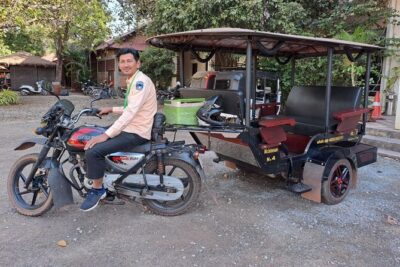
The base price is $45.00 per person, and the good news is that it covers a lot of comfort and guidance. You get hotel pickup and drop-off, an air-conditioned car, drinking water and cold towels, and a local English-speaking tour guide. That is not nothing in Siem Reap, where travel time and heat can drain your day fast.
But you do need to budget for the temple fee. The tour lists temple fee at $37.00 per person, and it also states that temple fees are not included in the tour price. So your all-in spend for the core sites is effectively $45 + $37, before tipping.
Tipping for the guide and driver is recommended, and while the exact amount is not stated, it is smart to plan for it. If you are trying to keep costs tight, decide ahead of time what you consider fair for the effort of both your guide and driver.
For value, the key question is whether you want guided context or just access. If you love history and want the stonework explained, you are getting real value because the guide is a highlight, especially with Dan’s storytelling style. If you only want photos and you can handle reading on your own, you might choose a less structured option. But even then, having someone explain the major symbols and how to see each temple properly is usually worth it.
Comfort tips that actually matter at these temples
This tour gives you water and cold towels, which helps. Still, you will want to handle the human basics well, because the temples are the whole point.
Dress for entry rules: You must cover knees and shoulders when entering temples. Even if you arrive looking ready, check what you are wearing before you leave the car, because you do not want to waste time fixing it on the spot.
Shoes matter: Comfortable walking shoes are recommended. That is your best friend here. Stone surfaces, long corridors, and uneven steps add up quickly, and you want stable footing more than you want fashion.
Avoid valuables: The tour advises not to bring valuables. That is not fear talk. In busy areas, you want to keep things simple and easy to manage while you are looking up at faces and carvings.
Plan your energy for the optional extra: The tour notes that there is another small temple added if you have energy. That is great if you are feeling good after Ta Prohm. If you are already tired, you can skip it without turning the day into a slog.
Who this tour suits best
This fits best if you want a guided small-circuit day that hits the famous temples in a manageable time frame. It is especially good if you like when a guide turns big sites into a story you can follow.
I’d also point to the guide quality. Dan is praised for being a strong storyteller with deep knowledge of Cambodian history, religion, and the political and cultural forces that shaped temple building. If you care about context, that makes the difference between seeing sites and understanding them.
If you are traveling with friends who argue about whether to care about history, this tour helps. You get the visuals first, then you get the meaning, and the pacing avoids the all-day fatigue that makes people cranky.
Should you book this Angkor Wat, Bayon, and Ta Prohm tour?
Book it if you want the classic trio with guided explanations, hotel pickup, and a calm structure that keeps the day from running over. The pricing is reasonable for Siem Reap once you factor in what is included, especially the air-conditioned transport and the local English-speaking guide, which is where you gain most of the value.
Skip or rethink it if you are trying to travel as cheaply as possible and you do not plan to pay temple fees anyway. Since the temple fee is significant, the cheap ticket approach does not work here. Also skip it if you hate walking and want a mostly seated experience, because these temples are still built for foot traffic.
FAQ
What temples are included in this tour?
This tour focuses on Angkor Wat, Bayon, and Ta Prohm. It also includes a stop at Angkor Thom South Gate, plus it may add an additional small temple if you have energy.
How long does the tour take?
The tour duration is listed as about 5 to 7 hours.
Do I get hotel pickup and drop-off?
Yes. Hotel pickup and drop-off are included.
Is the temple fee included in the price?
No. The temple fee is listed as $37.00 per person and it is not included.
What is included with the tour besides the guide?
Included items are an air-conditioned car, drinking water and cold towels, and a local English-speaking tour guide.
Is there a requirement for clothing at the temples?
Yes. You must cover your knees and shoulders when entering temples.
Do I need to bring tickets?
The tour notes that a mobile ticket is used.
Is tipping required?
Tipping for the guide and driver is not included, and it is recommended.
Can I cancel and get a full refund?
Yes, the tour offers free cancellation. You can cancel up to 24 hours in advance for a full refund.
Is the tour private or group-based?
It is listed as private, meaning only your group participates.
Ta Prohm and the Roots
- Siem Reap Tour: Angkor Wat Sunrise, Bayon, Ta Prohm, Banteay Srei
★ 5.0 · 931 reviews - Angkor Wat Private Driver Tours to Angkor Wat Sunrise, Angkor Thom & Ta Prohm
★ 5.0 · 98 reviews - Private Temples Guided Tour (Angkor Wat, Ta Prom & Angkor Thom)
★ 5.0 · 75 reviews - One Full Day Private tour of Angkor Wat, Ta Prohm, Angkor Thom & Banteay Srie
★ 5.0 · 64 reviews - Siem Reap Private Day Tour: Angkor Wat Sunrise, Bayon & Ta Prohm
★ 5.0 · 48 reviews
Through Angkor Thom to Bayon
- Siem Reap Tour: Angkor Wat Sunrise, Bayon, Ta Prohm, Banteay Srei
★ 5.0 · 931 reviews - Angkor Wat Private Driver Tours to Angkor Wat Sunrise, Angkor Thom & Ta Prohm
★ 5.0 · 98 reviews - Angkor Wat Sunrise and Angkor Thom Sunset Tour
★ 5.0 · 89 reviews - Private Temples Guided Tour (Angkor Wat, Ta Prom & Angkor Thom)
★ 5.0 · 75 reviews - One Full Day Private tour of Angkor Wat, Ta Prohm, Angkor Thom & Banteay Srie
★ 5.0 · 64 reviews
Angkor Wat, a Few More Ways In
- Angkor Wat Sunrise or Sunset Tour with Guide from Siem Reap
★ 5.0 · 12,109 reviews - Siem Reap: Angkor Wat: Small-Group Sunrise or Sunset Tour
★ 5.0 · 9,444 reviews - Siem Reap: Angkor Wat 2-Day Tour with Sunrise and Sunset
★ 4.9 · 4,429 reviews - Siem Reap: Full-Day Angkor Wat Guided Tour with Sunset
★ 4.9 · 3,803 reviews - Angkor Wat Sunrise tour with Small – Group and Guide tours
★ 5.0 · 3,655 reviews
Just Added: Fresh Siem Reap Tour Reviews

Angkor Wat Temple Tours, compared.
 ★ 5.0Angkor Wat Sunrise or Sunset Tour with Guide from Siem ReapFrom $1812,109 reviews
 ★ 5.0Angkor Wat: Small-Group Sunrise or Sunset TourFrom $159,444 reviews
 ★ 4.9Angkor Wat 2-Day Tour with Sunrise and SunsetFrom $344,429 reviews
 ★ 4.9Full-Day Angkor Wat Guided Tour with SunsetFrom $153,803 reviews
 ★ 5.0Angkor Wat Sunrise tour with Small – Group and Guide toursFrom $143,655 reviews
 ★ 5.0Angkor Wat Highlights and Sunrise Guided Tour from Siem ReapFrom $233,213 reviews
 ★ 5.0Angkor Wat Sunset Small Group Tour with Lunch IncludedFrom $203,059 reviews
 ★ 5.0Full-Day Angkor Wat Sunrise Private Tour with Guide from Siem ReapFrom $602,920 reviews
Browse the lists this tour appears in